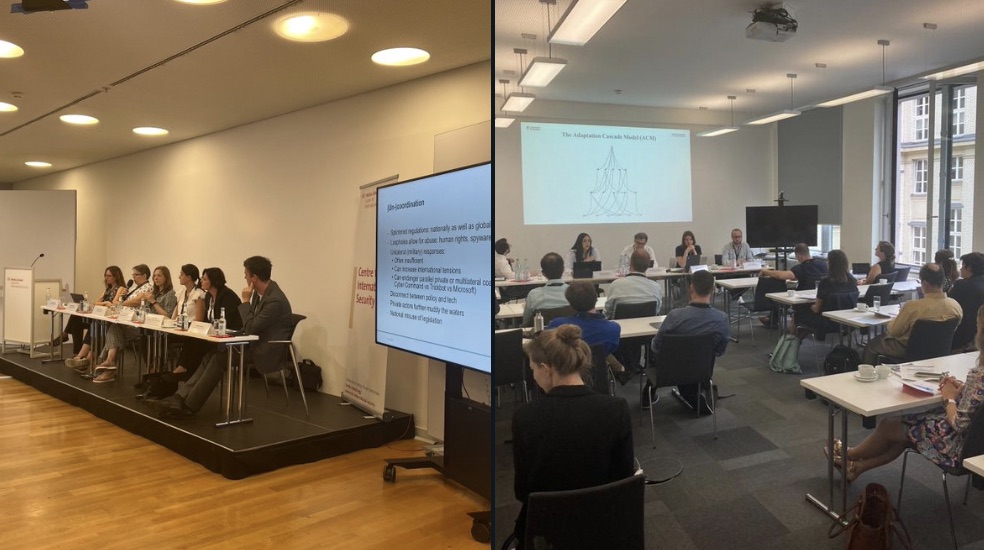
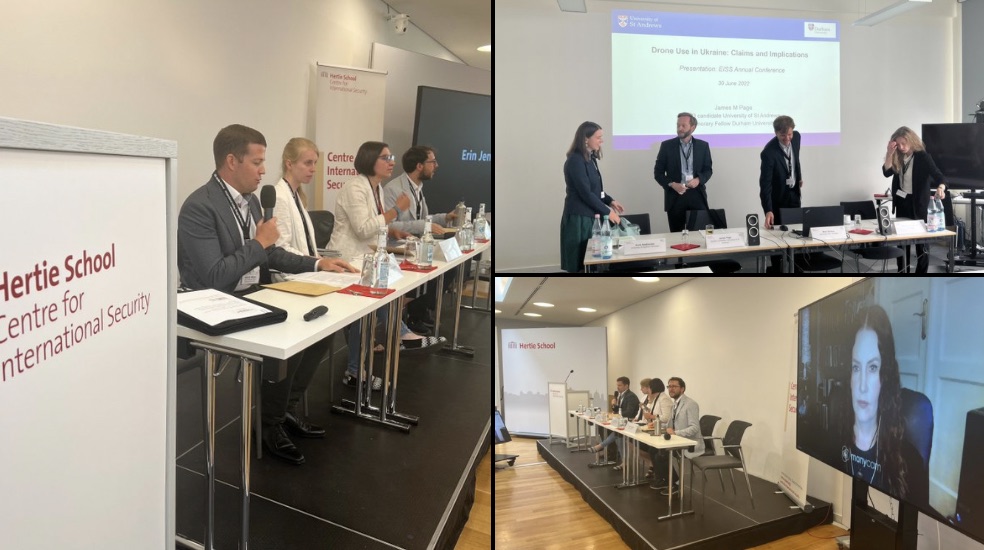
30 June — 1 July 2022 · Hertie School, Berlin, Germany.
About the conference
A new prize for early-career scholars
The 2022 edition at the Hertie School introduced the European Security Studies Best Paper
Prize for PhD students and early-career academics, presented for the first time at the
closing ceremony.
Conference gallery
From the archive
Conference programme
The full programme of panels, roundtables and papers, as it ran. Open a session to see its papers and speakers.
Discussants:Lindsay Cohn (Naval War College), Olivier Schmitt (University of Southern Denmark), Marc DeVore (University of St Andrews), Dominika Kunertova (University of Southern Denmark)
11h– to 12h30
Military Technology
Room 3.32 & 3.30
Chair:Marc DeVore (University of St Andrews)
View papers (3)
Un-Hyping Hypersonic Weapons
Presenter: Dominika Kunertova (ETH Zurich)
Cruise missiles and boost gliders that can travel faster than five times the speed of sound along an unpredictable trajectory have been portrayed in the public discourse as the game changer that will transform the global security environment and disrupt strategic stability. But then physics gets in the way and makes them appear less fast and agile than advertised. Their main advantages – speed, maneuverability, and accuracy – can be inhibited by limitations of flying hypersonic in the atmosphere. As military effectiveness and technical reliability of these weapons is uncertain, the magnitude of their disruptive effect remains a known unknown. The United States, Russia, and China’s heavy investments in hypersonic offensive capabilities manifest their great power rivalry and status seeking behaviour. Although it looks like China is getting FOBSsessed about evading American missile defences and Russia keeps polishing its Avangard glider, what we observe is a competition to become the first to achieve a technological edge, a political tool of great powers for demonstrating technological prowess and prestige. This is far from stating that hypervelocity weapons are not dangerous. Technological competing for pride can spiral into arms race, increase the risk of misperceptions, and contribute to nuclear build ups. Instead of musing about revolutionary technology and overestimating the capabilities of hypersonic weapons, it is important to look beyond the hype (and perhaps stop labelling a standard MARV-ed ballistic missile hypersonic). The hype cycle concept developed by the sociology of technology adoption can help avoid exaggerating short-term expectations and form a better understanding of the time and resources required for hypersonic and other emerging and disruptive technologies to mature. In the short to mid terms, the most tangible effect of hypersonic weapons will likely be the need to improve sensors on existing layered defence systems and make them more integrated and continent-wide.
Technology as Status Anchor: How Russia Perceives Artificial Intelligence
Presenter: Anna Nadibaidze (University of Southern Denmark)
Drone Use in Ukraine: Claims and Implications
Presenter: James Page (Durham University and University of St Andrews)
External Sponsorship and Conflict Intervention
Forum
Chair:Erin K. Jenne (Central European University)
View papers (4)
Carpe Diem: When Foreign Sponsors Intervene Directly in Civil War
Presenter: Giuseppe Spatafora (University of Oxford)
The logic of proxy war suggests that states may delegate fighting to civil war parties when they want to avoid direct confrontation with their rivals. Yet, from Vietnam and Afghanistan during the Cold War to the contemporary cases of Libya, Ukraine and Syria, foreign states may end up intervening directly in support of their beneficiaries, deploying advisors, special forces, and even ground troops. Despite the countless number of studies on the use of force, including external intervention in civil war, we lack an understanding of why, and when, foreign sponsors would decide to directly intervene in a civil war by sending combat forces and not limit themselves to indirect support such as weapons and training. What drives the escalation of foreign support to direct intervention? This paper develops a logic of support escalation combining poor conflict evolution, foreign leaders' commitment, and the need for quick reversal of battlefield outcomes. Because there are several forms of escalation, sponsors will only provide direct support when (1) the costs of proxy war are about to rise significantly and (2) the proxy's forces lack combat effectiveness to obtain meaningful battlefield success. To compensate for the proxy's losses in a short time, foreign states may end up escalating the extent of their commitment, thereby abandoning the initial logic of limited war. The paper applies the logic of support escalation to a number of contemporary cases, before delving into the case of the Spanish Civil War and tracing the origin of Fascist Italy's increasing involvement via the analysis of primary documents. The paper further probes the generalizability of the argument with a large-N analysis of direct intervention in civil wars from 1975 to 2018.
The Uneasy Relation of Proxy War and States' Interests. Pursuing Strategic Opportunities in Civil Wars
Presenter: Natalia Tellidou (European University Institute)
It is not surprising that legitimate third-party intervention occurs rarely. After the 2011 NATO-led military intervention in Libya, requiring the coordinated effort of three great powers to pass a once-in-a-decade UN Security Council Resolution to use all necessary measures, states searched for more tenable foreign policies. Sponsorship of warring actors in civil wars rose as the favoured foreign policy, simultaneously bearing less in political costs and more in opportunities to influence. With the state not having to participate as an active actor in the civil war and the political consequences of such a controversial policy for governments being significantly reduced, a way into interfering in the internal affairs of other states was found. Despite this turn in policymaking, studies of conflicts explain the recent trend that consistently reached a record high for the past four years on the principal explanation of third-party intervention: bilateral rivalry. Why do states intervene in civil wars if they have no rivals in the civil war? This paper looks at recent proxy wars, where both warring sides receive external support, and uses Comparative Case Analysis to examine the strategies that states employ. The results show that in many cases, states that intervene in civil wars and are rivals with other external actors tend to escalate their efforts to a military intervention. When states intervene in conflicts having other preferences, they tend to abandon their efforts to change the outcome. States use different strategies when engaging in proxy wars that connect with their policy priorities in the conflict. These priorities connect with rivalry but also with other preferences. The QCA confirms this argument and suggests alternative pathways to a proxy war.
If You Can't Beat 'em, Join 'em: Conceptualizing Non-State Armed Group Interaction
Presenter: Michel Wyss (Leiden University & Military Academy at ETH Zurich)
Why do some non-state armed groups (NSAG) in multiparty civil wars form collaborative interactions with each other while others do not? This paper argues that to understand the conditions of such interactions, closer attention needs to be paid to the question of how such NSAGs interact with one another. Previous research, which focuses on either conflict or cooperation among NSAGs, typically treats these processes as separate and binary phenomena and thus offers only partial explanations. In contrast, the paper proposes a novel framework that conceptualizes NSAG interaction on a single continuum, drawing insights from various research clusters such as terrorist cooperation and state-militia relations. The paper distinguishes between three basic types: collaborative, competitive, and contentious interaction, all of which are dynamic and can evolve over time. Its findings indicate that contentious interactions are particularly prevalent among asymmetrically capable NSAGs. Using several case studies such as the Syrian Democratic Forces (SDF) or the relations between Hezbollah and the Lebanese Resistance Brigades, the paper argues that rather than collaborative interactions, many ostensible alliances between powerful non-state armed groups and smaller militant organizations should instead be considered specific types of proxy relations, namely non-state sponsorship. In doing so, the paper not only offers a more comprehensive account of how non-state armed groups interact with one another but also expands the scope of research into proxy relationships, which has typically been limited to state-centric approaches.
The Logic of Diaspora Sponsorship to Rebel Organizations
Presenter: Sara Daub (Hertie School)
While the last decades of intrastate conflicts have taught us the relevance of state sponsorship on rebel organizations, less is known about the influence of non-state actors. Case studies on the Kurdish or Tamil diaspora illustrate the importance of material and political sponsorship for rebel organizations but little is known beyond individual cases. In this paper, I examine in a global setting why diasporas support rebel groups. To understand the logic of diaspora support, I develop a new principal-agent model for diaspora support to a rebel group, with co-ethnicity as a key factor. I also review the formation and mobilization of diaspora as an external actor in civil wars. The starting point of the sequential game is the diaspora's decision to support a rebel group. The results show that kin support can be identified as a key determinant of external diaspora support of rebel groups in intrastate conflict. The paper contributes to the limited literature on diaspora support and offers further avenues for empirically testing the proposed mechanisms in the principal-agent model in a large-N framework. The findings have important implications for our understanding of the agency of non-state actors.
Notwithstanding its widespread use, what military professionalism means remains unclear. Some have used it as a synonym for an all-volunteer force, while for others its key ingredient is a technologically modern military or a military organization subordinate to civilian control. In this paper, we review and critically discuss the most common usages of the term military professionalism and conclude that the concept has become severely over-stretched, hampering the production of cumulative knowledge and of military assistance projects. We propose four mid-range concepts to capture in more precise ways the components of military professionalism. For each, we propose definitions that should also help deconstructing deeply-ingrained Western-centric assumptions attached to the concept.
The Democratic Military in Internal Missions: Professionalism in an Era of Climate, Health and Humanitarian Crises
Presenter: Risa Brooks (Marquette University)
Many conceptions of military professionalism in democracies assume that the military's role is primarily to address external challenges and confront foreign adversaries. Yet, militaries in democracies are increasingly being drawn into addressing internal crises. This has been especially evident in the COVID-19 pandemic, in which military personnel have been involved in everything from administering vaccines and testing to border control, and in some cases public advocacy and legitimatization of a government's policies. In recent decades militaries in democracies have also increasingly been involved in counterdrug, immigration, counterterrorism and policing functions. This trend is unlikely to reverse any time soon, given the growing climate crisis, the popularity of militaries in many democracies, and civilian politicians' inclinations to call upon them to manage domestic challenges. These internal missions are particularly worrisome in that research suggests they may politicize the military and draw it into domestic politics in new ways. Given these trends, this paper argues that new and more robust conceptions of military professionalism need to be developed. Its aim is to outline the particular challenges that come from military involvement in internal crises and to propose several key principles that could underpin a conception of professionalism adapted to the contemporary era.
Military Politics on the Battlefield: Strategy and Effectiveness in War
Presenter: Carrie Lee (US Army War College)
Huntingtonian norms that advocate for a sharp divide between military strategy-making and its execution are increasingly being challenged today. While much of the analysis has focused on the implications for civilian control and democratic health, less attention has been paid to their implications for battlefield effectiveness. Those that do address effectiveness in war overwhelmingly cite the emergence of 'gray zone warfare' and modern war as the forces behind the need to re-evaluate the civil-military relationship. This article uses an historical lens to argue that the Huntingtonian norms have, in fact, never been effective at ensuring battlefield success for three reasons. First, military strategies must be tied to political objectives, even and especially as they change over time. Second, the ends-ways-means strategy-making process requires integrating both decisions about resources – a fundamentally political decision – and military objectives. Third, in democracies, military leaders must be aware of the constraints that public opinion places on elected leaders and ensure that military strategies can sustain public support for victory. Using evidence from the invasion of North Africa during World War II (also known as Operation Torch), the paper shows that even in the most conventional conflicts, the most effective military commanders are those who take the political constraints and strategy-making process seriously.
Military Professionalism under Political Polarization
Presenter: Lindsay Cohn (US Naval War College)
Traditional conceptions of military professionalism tend to emphasize the need for service-members to be 'apolitical' or at least non-partisan. These professional norms, however, tend to assume that members of the military can 'just say no' to being political or partisan, and provide little guidance on how to avoid or resist political pressure. This lack of guidance becomes particularly problematic in a context of high and increasing partisan polarization, as more issues become partisan and thus theoretically out of bounds for military members to engage in. This paper explores precisely why partisan polarization creates significant problems for normative civil-military relations theory, and attempts to offer an alternative concept of a professional ethic that provides more guidance for military members under conditions of polarization.
The Human Dignity Case Against Administrative Detention
Presenter: Eden Lapidor (Georgetown University Law Center)
Blurring the Lines: Sovereignty and Consent in the Fight against Terrorism
Presenter: Renée de Nevers (Syracuse University)
Between the Scylla of 'Ontological Lethargy' and the Charybdis of 'Epistemological Terrorism': Revisiting the critical vs orthodox divide in Terrorism Studies
Presenter: Andreas Gofas (Panteion University of Social and Political Sciences, Athens)
16h30– to 17h
Coffee Break
Cafeteria
17h– to 18h30
Roundtable 2: Navigating the Academic Job Market
Forum
Chair:Fabrizio Coticchia (University of Genoa)
Discussants:Stephanie Hofmann (Chair in International Relations, European University Institute), Nicolas Blarel (Associate Professor & Director of Studies at the Institute of Political Science, Leiden University), Aviva Guttmann (Lecturer, Aberystwyth University), Matthew Uttley (Professor and former Dean of Academic Studies, King's College London)
Military Expenditure, External Threats and Fiscal Consolidation: A Survey Experiment in Italy
Presenter: Alessia Aspide (Leiden University) · Jordan Becker (USMA West Point) · Matthew Di Giuseppe (Leiden University)
Norm Violation, Sanctions, and the Punitive Use of Force
Forum
Chair:Simon Koschut (Zeppelin University)
View papers (4)
Norm Violations and Punishment Beyond the Nation-State. Normative Orders, Authority, and Conflict in International Society
Presenter: Wolfgang Wagner (Vrije Universiteit Amsterdam)
This paper provides a theoretical framework for the study of punishment beyond the nation-state. It maps the main debates on punishment in various disciplines, including sociology, criminology, psychology, political science/international relations, history, and international law. Furthermore, it introduces basic concepts such as punishment, revenge, retribution, and restorative justice, and outlines the main penal philosophies and approaches to punishment. Special attention is given to whether and how international security has thus far been addressed in the various disciplines. The paper highlights the value-added of studying international politics through an inter-disciplinary lens of punishment. This value-added is threefold: punitive practices in international society tell us about the international normative order, i.e. the core values and norms of international society; punitive practices tell us about the (shifting) power structures and (changing) sites of authority in international society; and the penal philosophies tell us about the potential for conflict and cooperation in international society.
This paper makes a two-fold contribution: First, it historicizes international punishment through select colonial illustrations and acknowledges in broad brush strokes its myriad manifestations across time. Second, it suggests that punishment is an enduring trope of world politics evident in its continuing complicity with asymmetries of power manifest in a neo-colonial international present. To accomplish this objective, the chapter takes recourse to two distinct registers: first, select literary voices from the global south that chronicle these political moments with an unmistakable moral clarity; and second, a Third World Approaches to International Law (TWAIL) perspective on international punishments. These narratives also provide an opening to rethink and rehabilitate our current notions of political justice in international society.
Sanctions and the Authority of Legitimate Punishment in International Politics
Presenter: Elin Hellquist (Stockholm University)
Much criticism of sanctions revolves around their lack of legitimacy as explicitly harm-oriented tools of external interference into the domestic affairs of states. Applying insights from legal theory and experimental psychology, this paper argues that the legitimacy of international actions principally depends on whom the sender is. The paper distinguishes three types of senders in the contemporary sanctions landscape: the United Nations as an embodiment of universally shared norms and values, individual states imposing foreign policy sanctions alone or in coalitions, and regional organisations acting against their own members in case of violated core community norms. Scrutinizing legal bases and political justifications for all three groups of senders, the paper finds that regional organisations have a unique chance to clear up sanctions' legitimacy deficit. First, their sanctions are constructed as in-group measures, which softens their association with external interference. Second, their sanctions follow from a mutual contract between the regional community and its individual members. Third, regional organisations prioritise solving acute normative crises over protracted symbolic posturing, and consequently combine punitive isolation with positive modes of engagement.
Punishment, Panopticum and the Contingency of Legal Norms - A Legal-Philosophical Perspective of the War in Ukraine
Presenter: Cornelia Baciu (University of Copenhagen)
11h30– to 13h
Military Interventions
Room 3.32 & 3.30
Chair:Kristen Harkness (University of St Andrews)
View papers (4)
Russia's Way of War: Comparing Russian Strategy and Operations in Ukraine and Syria
Presenter: Nicolò Fasola (University of Birmingham)
The Adaptation Cascade: The Global Diffusion of All-Female Military Units in Military Interventions
Presenter: Cristina Fontanelli (University of Genoa)
Trade-Offs in the Use of Military Power: Lessons Learned from French Military Operations Abroad
Presenter: Olivier Schmitt (University of Southern Denmark)
Visualizing American Military Interventions Abroad
Presenter: Hubert Zimmermann (University of Marburg)
Cybercrime and International Security
Forum
Chair:Mischa Hansel (University of Hamburg (IFSH)), Anja Jakobi (Technical University Braunschweig)
View papers (4)
Unpacking Cyber Affordances in the Context of State-Cybercrime: A Criminological Perspective
Presenter: Anita Lavorgna (University of Southampton)
Criminological literature on crime and deviance in cyberspace has boomed in recent years, with most studies focusing on computer integrity crimes, computer content crimes and financial cybercrimes, also discussing the opportunity to consider some of these crimes as profit-driven forms of organised crime. The existing literature, however, has not yet addressed extensively the impact of the emergence and proliferation of cybercrimes on forms of state-organized crime – a conceptualization that since the late 1980s proved successful in shedding light on the relationships among social structures, criminality, and political economy. Seeking to address this gap, this contribution focuses on state-cybercrimes, where illegal, harmful or unjust cyber activities are committed for the benefit of a state or its agencies, offering a typology and discussing its heuristic value to shed light on how cyber affordances influence and transform the state-crime relations.
On the Peace and Security Implications of Cybercrime – The Need for an Integrated Approach
Presenter: Jantje Silomon (Institute for Peace Research and Security Policy at the University of Hamburg)
The UN Cybercrime Negotiations: Harmonisation and Universality or Polarisation and Fragmentation?
Presenter: Tatiana Tropina (Leiden University)
In December 2019, the UN General Assembly adopted resolution 74/274, establishing an open-ended ad hoc intergovernmental committee of experts tasked with elaborating a comprehensive international convention on countering the use of information and communications technologies for criminal purposes. It is not clear whether the negotiations will result in a global cybercrime treaty; however, there are already concerns that the outcome could potentially deviate from widely accepted standards such as the Council of Europe Cybercrime Convention and, instead of harmonising approaches to cybercrime, fragment them. The paper focuses on this possibility of misalignment between existing and new approaches and its potential ripple effects, which could go beyond the issue of cybercrime. The analysis looks at the UN cybercrime negotiations from two angles. First, the potential deviation of the future UN cybercrime treaty from existing standards on cybercrime and the consequences of this lack of harmonisation. As the ability to investigate crime and exchange digital evidence cross-border concerns not only high-technology crime but any crime leaving digital traces, the outcome of the UN process, if it creates a 'parallel' set of standards, can affect criminal justice systems in various countries and globally for years to come. Second, while the processes related to cybercrime and international cybersecurity are separated on the UN level, the link between the two should not be underestimated. The UN cybercrime negotiations can result in a set of rules that potentially affect the outcome of the work of the OEWG and GGE. As the goal of negotiations is a binding treaty, the paper examines whether there is a possibility for the UN cybercrime process outcome to override the non-binding nature of some of the existing cyber norms.
Business as Usual or New Forms of Collaboration? Non-State Actors in UN Cybercrime Governance
Presenter: Lena Herbst (Technical University Braunschweig)
This paper examines varying inclusion of non-state actors in UN cybercrime governance. While the criminal use of cyberspace is a prime example for a non-traditional security threat with political, economic as well as societal consequences, there is limited research on how traditional multilateral organizations react to the growing importance of non-state actors in this field. Recent developments in some UN forums have called for more inclusion of non-state actors as important, although contested, parts of cybersecurity governance. While the transboundary and rapidly evolving nature of cybercrimes necessitates collaboration to share resources and responsibility, recent debates in different UN cybersecurity fora reflect states' reluctance toward multistakeholder involvement due to long-term geopolitical divisions. Going beyond these debates, this paper aims to better understand current variance of non-state actors' inclusion in UN cybersecurity fora. The paper is structured as follows: we first introduce the role of non-state actors in crime governance more broadly. We then put forward arguments for variance in the inclusion of non-state actors to UN cybersecurity institutions, relying on arguments linked to institutionalism, resource-exchange theory and those that emphasize the legitimacy of decision-making. In a further step, we present current debates on cybercrime as subfield of cybersecurity governance in the UN and the role non-state actors play in these. We then compare non-state actor engagement across different UN bodies and fora and evaluate arguments for their inclusion. The paper is a first step in examining the diversity of non-state actor engagement, showing a large diversity in cooperation that deserves closer attention. It combines existing empirical research on cybercrime governance with new insights from an ongoing PhD project on the UN and cybersecurity.
Does Russian Antagonistic Strategic Narration Trigger Destabilising Psychological Effects? An Experimental Study in Sweden and the Netherlands
Presenter: Aiden Hoyle (University of Amsterdam)
The security threat posed by information influence is often attributed to its potential to trigger societal destabilisation. This is particularly problematic in the European setting where a number of societies are experiencing increased polarisation. An element of this destabilisation is psychological: strategic narratives influence how citizens of targeted societies comprehend and interpret the (international) political reality. If this is antagonistically skewed, it could lead to a myriad of destabilising psychological responses being elicited in these citizens. There is, however, little attention from psychological science as to if, and if so which, psychological effects of (antagonistic) strategic narratives are provoked. This study aims to make a first step in identifying causal links between Russian antagonistic strategic narratives targeting European states and societies and possible psychological responses. Drawing on extant qualitative analyses of Russian antagonistic strategic narratives about Sweden and the Netherlands, it tests a transdisciplinary model that links Russian state-sponsored narrative strategies to key types of perceived threat, and that subsequently predicts different cognitive and emotional responses. This study acts as a basis for future research analysing in more longitudinal research paradigms. Insights into causal links between particular Russian narratives and psychological responses in citizens can aid with, for example, more accurate measurement of the impact of Russian information influence, better preparation of the society against this type of security threat, and better construction of possible counternarratives.
News Media and (In)Security in Ukrainian Border Regions: An Assessment of Threats and Vulnerabilities
Presenter: Joanna Szostek (Glasgow University)
Since 2014, the Ukrainian government has implemented wide-ranging measures to reduce the impact of hostile narratives and disinformation spread by Russia. These measures (including bans on certain TV channels and websites) have been quite successful at reducing overall use of Russian news sources within Ukraine. Nevertheless, significant concerns remain about foreign influence exerted via the news media, particularly in Ukraine's border regions, where linguistic and cultural ties to the neighbouring state(s) remain strong. This paper presents findings from a comparative study of news use in three diverse peripheral locations in Ukraine – Odesa, Sumy and Zakarpattia regions – as well as the political centre, Kyiv. The paper uses original, regionally representative survey data to explain variation in the level of attention that Ukrainian citizens pay to local, national and cross-border news media, considering both supply-side factors (such as ease of access) and demand-side factors (including language preferences and political interest). The paper then studies how different news diets and levels of engagement with foreign sources affect support for democracy and norms of good citizenship, as well as belief in disinformation. The paper aims to prompt deeper reflection about the relationship between media use and national security, in a world where citizens increasingly inhabit 'borderless' digital media environments.
How RT and Sputnik Cover the News in Mali: a Textual Analysis of Russia's Information Influence in Francophone Africa
Presenter: Maxime Audinet (Institute for Strategic Research (IRSEM))
After an abrupt disengagement following the fall of the Soviet Union, Russia stepped up its presence in Africa in the late 2000s. In October 2019, the Sochi summit materialized this comeback. Its main markers are, on the one hand, official military-technical cooperation and, on the other hand, the rising role of the Wagner Group, a private military company presumably sponsored by the Russian businessman and 'entrepreneur of influence' Evgeny Prigozhin. In parallel, the footprint of Moscow's information influence has expanded and diversified in the areas where these actors have settled in, mostly for the purpose of legitimizing the Russian presence and disparaging the interventionism of Western actors. While the Central African Republic is the country where this influence has penetrated the most, Mali deserves particular attention as this Sahelian country has become a potential area of significant information conflict between France and Russia: Mali is the main theatre of the ongoing French operation Barkhane and the European Takuba Task Force, and the Wagner Group has been deploying there since December 2021, after the announcement of a partial withdrawal of the French military from the Sahel region. This paper explores the way in which the French-speaking branches of RT and Sputnik, the two state-funded networks of Russia's controversial mediated public diplomacy, have covered the news in Mali since the end of 2020. Using lexicometric analysis (IRaMuTeQ), it examines the contents published by RT and Sputnik on their websites, emphasizing the narratives they promote and the value judgements and rhetorical devices they rely on while covering the French and Russian presences in the country. The findings are discussed in light of the security challenges raised by new forms of information warfare in Europe and Africa.
The Online Reception of Russia and Chinese News Coverage of the US 2020 Election
Presenter: Thomas Colley (Royal Military Academy, Sandhurst)
As the Digital Age evolves, states are investing increasingly heavily in international news to compete for influence internationally. Among authoritarian states, Russia and China have invested particularly heavily, using state-subsidised outlets like RT and CGTN. Much of this is aimed at gaining relative influence versus liberal democracies in Europe and North America. While these efforts are gaining increasing attention, few comparative studies have examined how differently authoritarian states use international news to disseminate strategic narratives. Still fewer studies have examined how strategic narratives projected via state-sponsored news are received by international target audiences. This paper compares the online reception of RT and CGTN news coverage of the 2020 US presidential election on their websites, Twitter, Facebook and YouTube. It then considers the security implications of this for other liberal democracies, particularly in Europe. Examining both the content and the style of RT and CGTN's coverage, the paper shows how RT's coverage appears to be more emotionally engaging, and more noticeably tailored to different social media platforms. CGTN's more official, more dispassionate election coverage received far more muted engagement. Amid fears about the effectiveness of authoritarian state propaganda, the paper reveals that online audiences are extremely sensitive to content they perceive to be propaganda – with news content on both sites immediately rebutted by many commenters. This suggests that, rather than these news channels speaking to echo chambers of like-minded audiences, the online reception of their content is far more varied than sometimes appreciated. With ongoing concerns about subversion and electoral interference, the paper raises questions about how significant the impact of authoritarian strategic narratives really are.
Roundtable 3: Devising an Effective Publication Strategy
Forum
Chair:Silvia D'Amato (Leiden University)
Discussants:Sarah Kreps (associate editor for International Security in the Cambridge Elements series, Cornell University), Joe Maiolo (Editor-in-Chief, Journal of Strategic Studies & member of the Editorial Board, Intelligence & National Security), Mathilde von Bulow (Editor, War in History), Eirini Karamouzi (Former Book Editor, Cold War History)
17h30– to 17h45
Award of the European Security Studies Best Paper Prize
Forum
17h45– to 18h
Concluding Remarks
Forum
Chair:Marina Henke (Hertie School), Hugo Meijer (Director of EISS / Sciences Po)
18h
Cocktail
Maximilians, Friedrichstraße 185-190, 10117 Berlin
Reconstructed from the conference's final printed programme.