The first continent-wide dataset on European expert risk perceptions

“‘Global Risks to the EU’ (RISK-EU) is a large-scale survey designed to quantify expert perceptions of conflict-related threats to European Union security. First launched in 2025 by the Robert Schuman Centre for Advanced Studies (RSCAS) at the European University Institute (EUI), in collaboration with the European Union Institute for Security Studies (EUISS), the Trans European Policy Studies Association (TEPSA), and the European Initiative for Security Studies (EISS), ‘Global Risks to the EU’ constitutes the first continent-wide dataset on global risk perceptions among European experts. A target high-knowledge sample of 500 respondents rank the likelihood and expected impact of 30 predefined risks affecting EU security.”

The survey is a yearly academic endeavour, designed to capture trends in threat perceptions over time. Its methodology draws on the Council on Foreign Relations' Preventive Priorities Survey, which has assessed global risks to US interests since 2008, and is coordinated with it so that European and American foreign-policy priorities can be compared systematically.
Global Risks to the EU 2026

The second edition was fielded from 12 November 2025 across the expert networks of the EUI, EUISS, TEPSA and EISS, and published in 2026 by Veronica Anghel, who leads the project at the Robert Schuman Centre.

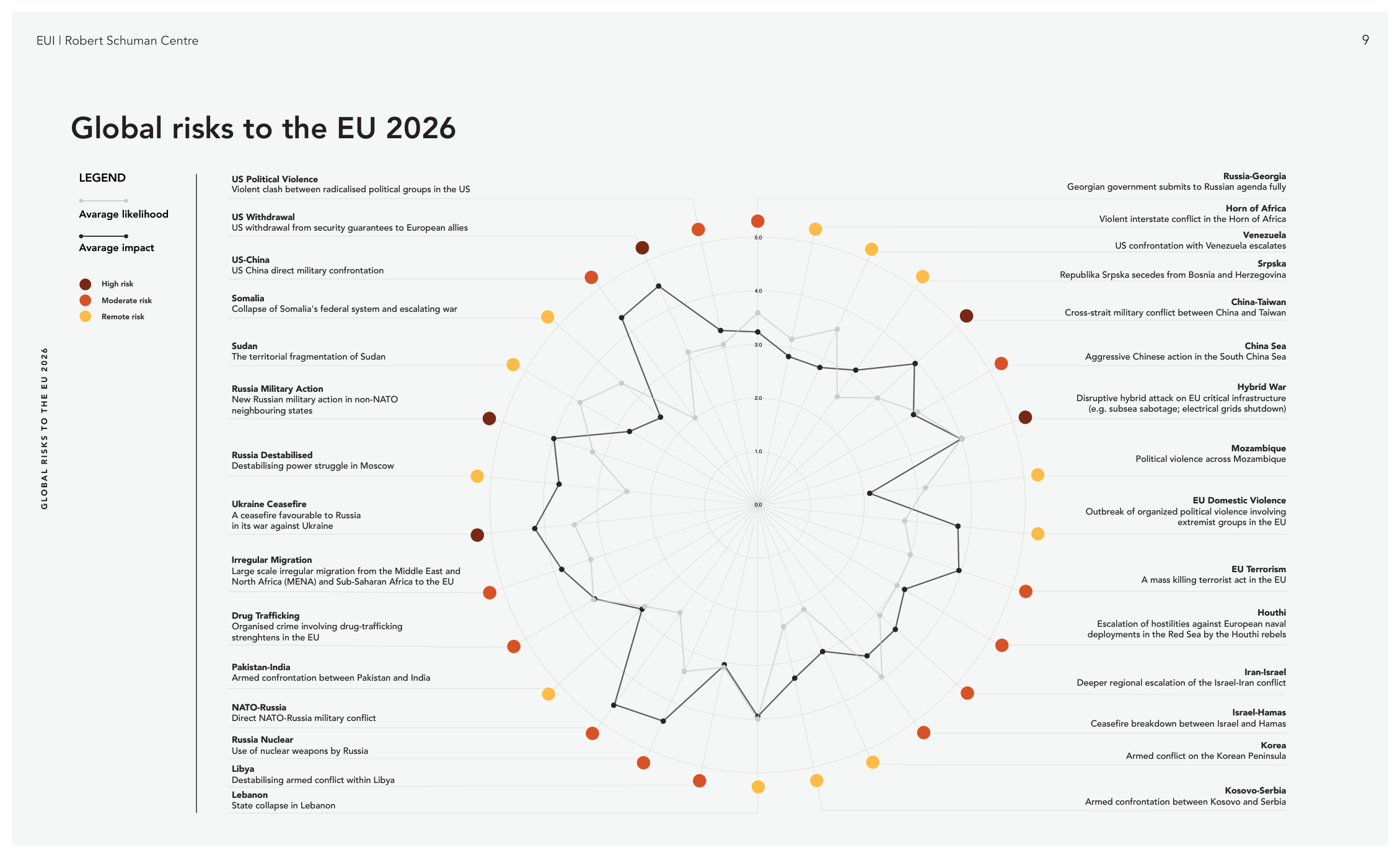
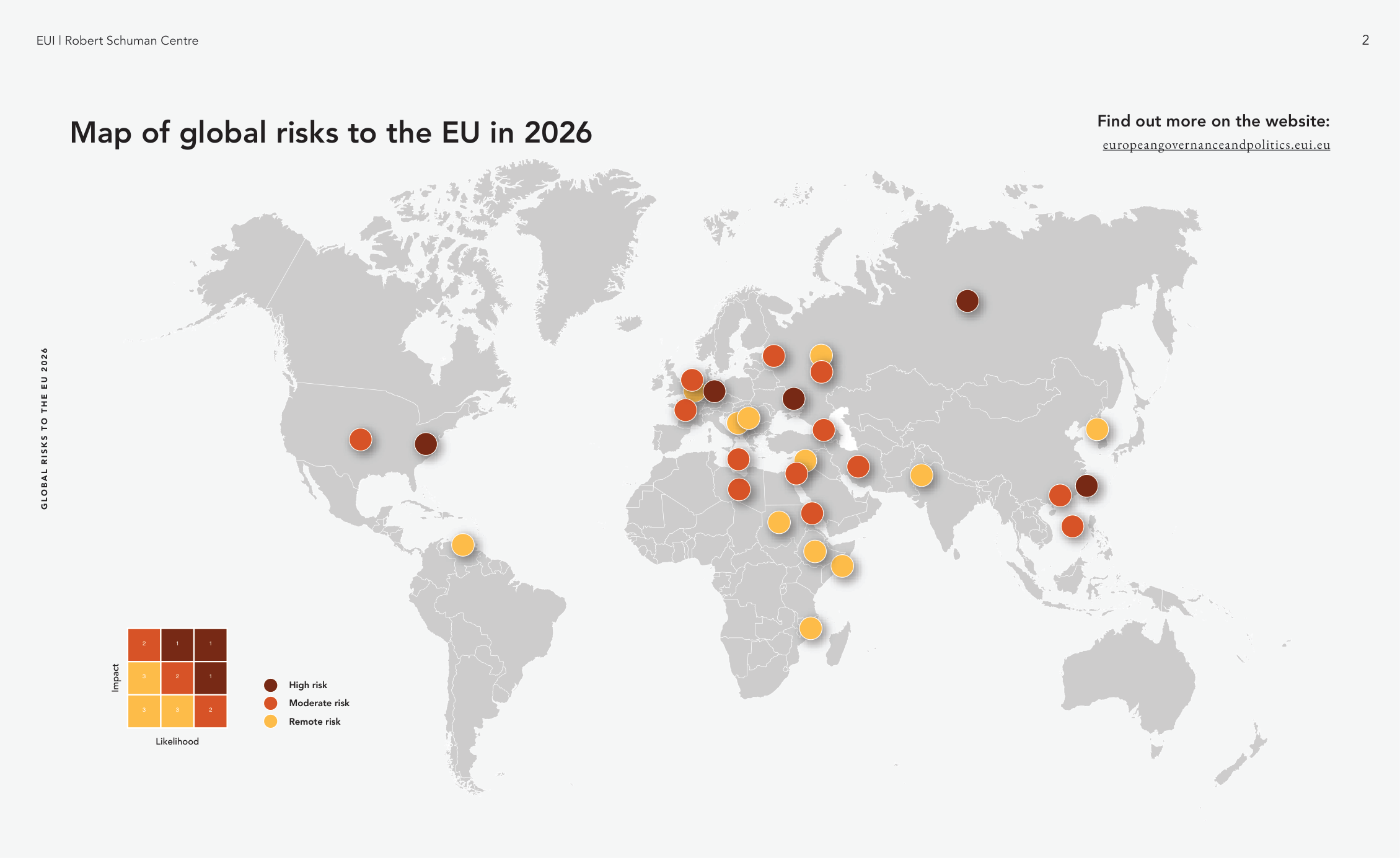
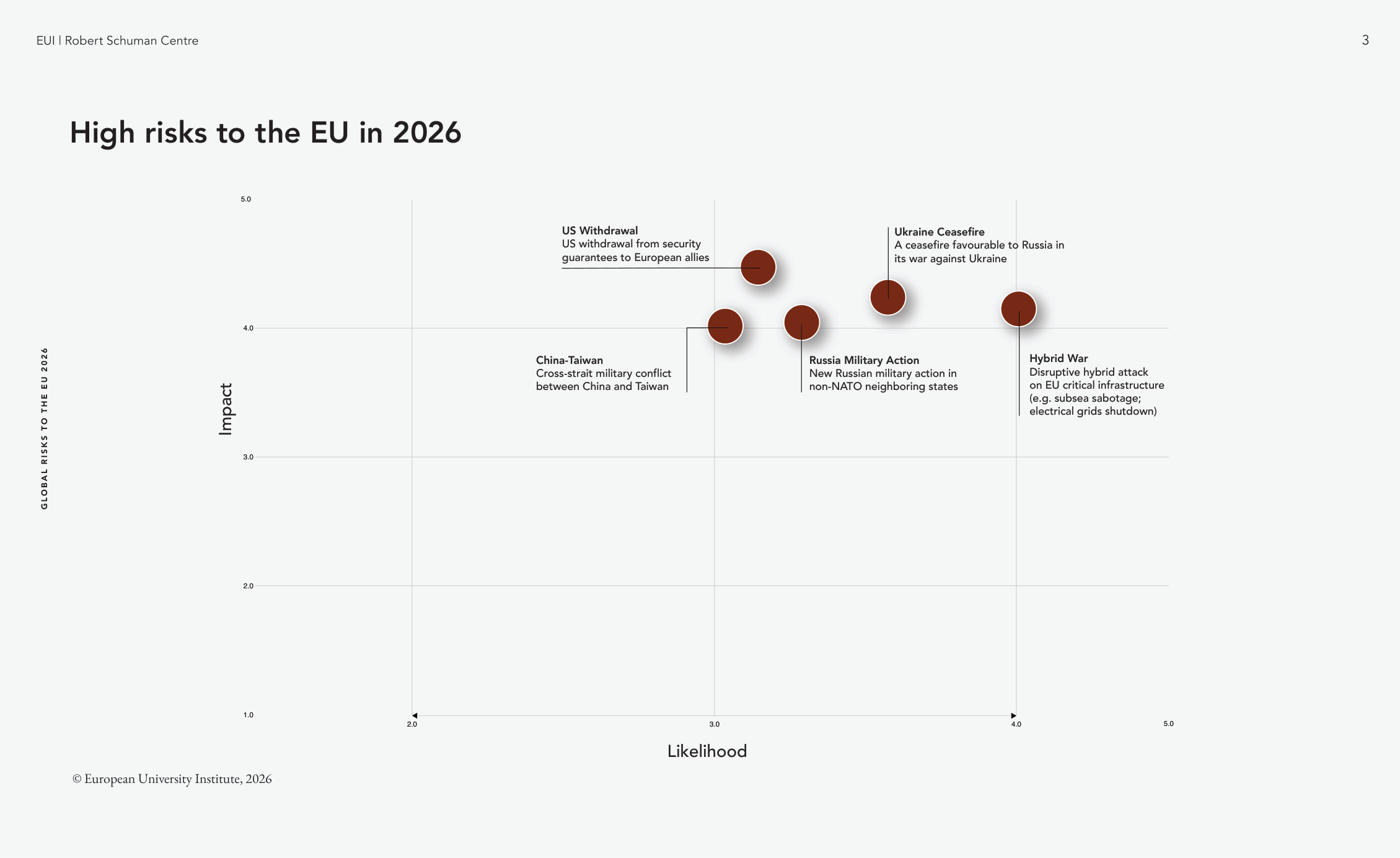
The 2026 risk map shows a sharp concentration of concern around hybrid warfare, the Russia–Ukraine war, and the reliability of US security guarantees. Combining likelihood and impact, five scenarios stand out as high risks to EU security in 2026:

  • A disruptive hybrid attack on EU critical infrastructure (subsea sabotage, power-grid shutdowns) — rated the single most likely scenario, and among the most damaging.
  • A ceasefire in Ukraine on Russia's terms.
  • A US withdrawal from security guarantees to European allies.
  • New Russian military action in non-NATO neighbouring states.
  • A cross-strait military conflict between China and Taiwan.
Taken together, these results depict an EU that is most vulnerable not to a single spectacular war, but to overlapping shocks that target its infrastructure, its neighbourhood, and its main security provider at the same time. Global Risks to the EU 2026, principal findings
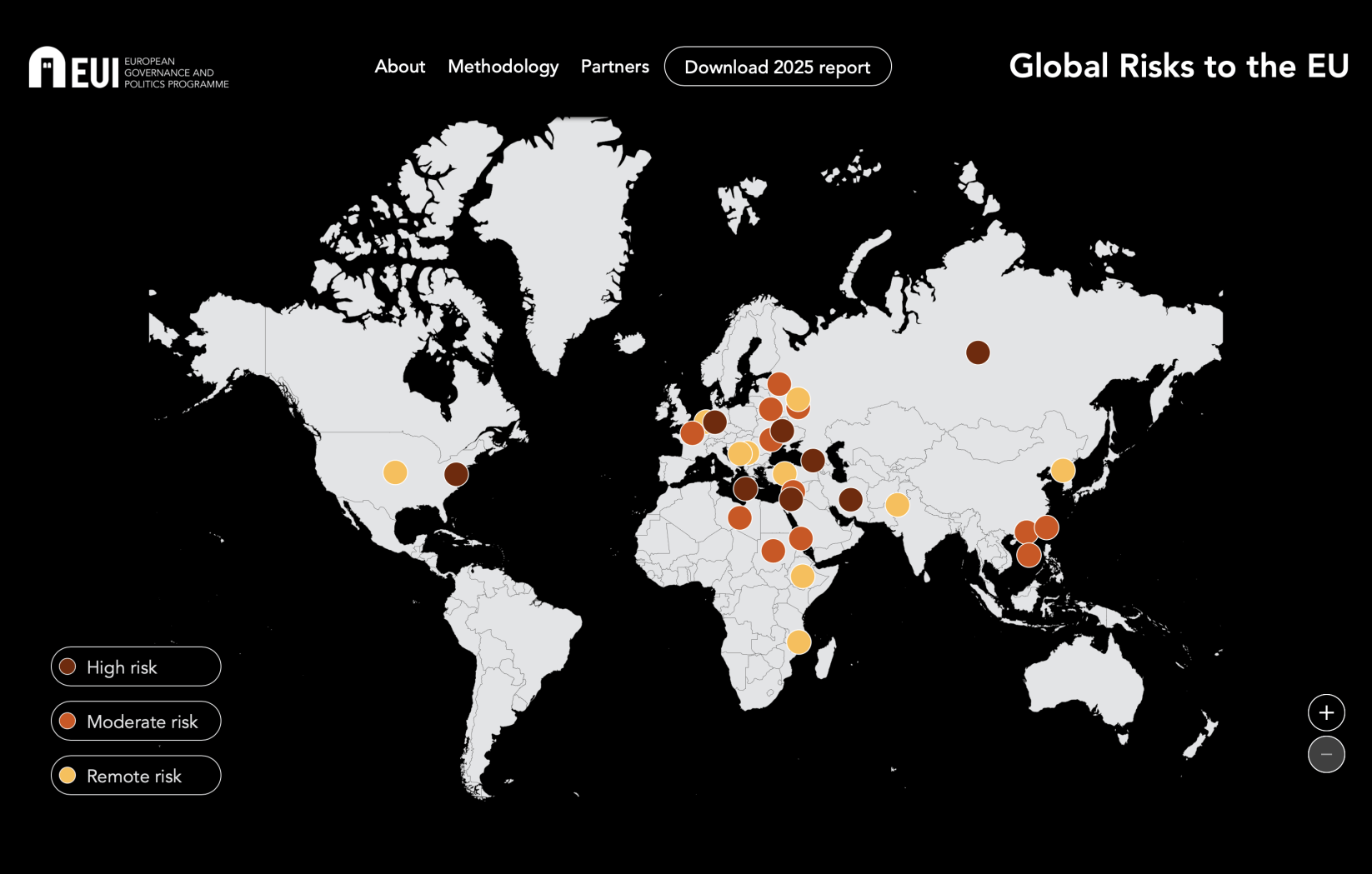
World map of global risks to the EU in 2026, with each risk plotted by location and shaded high, moderate or remote.
Scatter chart of the five high risks to the EU in 2026, plotted by likelihood against impact.
Radar chart ranking all 30 risks to the EU in 2026 by average likelihood and average impact.

Figures from Veronica Anghel, Global Risks to the EU 2026, © European University Institute, 2026, licensed CC BY 4.0.

Download the 2026 report (PDF) → Explore the interactive map →

Global Risks to the EU 2025

The inaugural 2025 edition established the baseline. Respondents scored each risk on both how likely it is and how severely it would affect the Union; the results are mapped geographically and ranked by expected impact. Both editions remain available on the EUI's interactive map via its year selector.

Global Risks to the EU 2025 — overview chart.
Global Risks to the EU 2025 — detailed risk breakdown.
Global Risks to the EU 2025 — ranked risk impact.

Full results and annual reports

The project is led by Veronica Anghel within the European Governance and Politics Programme at the European University Institute, and run with the EU Institute for Security Studies, the Trans European Policy Studies Association, and EISS. The interactive map, the methodology, and each annual report are maintained on the programme's own site, where the year selector switches between the 2026 and 2025 editions.

Open the project at the EUI →