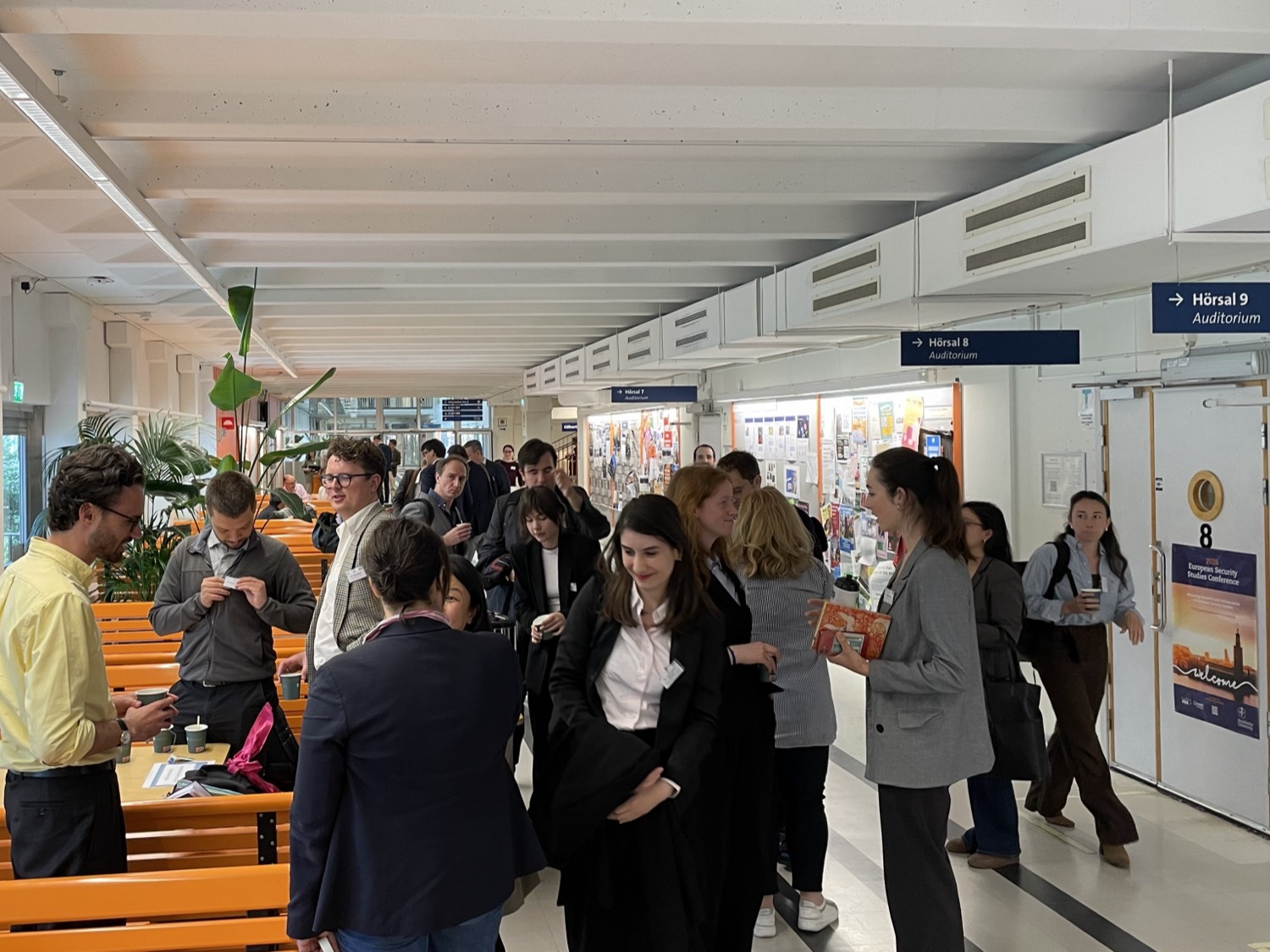
Registration and Coffee

2026 — Stockholm
11.–12. Juni 2026 · Universität Stockholm, Schweden.
Rückblick
Zwei Tage in Stockholm
Die European Security Studies Conference 2026 brachte die Community für zwei Tage mit Panels und Round Tables an die Universität Stockholm, gemeinsam organisiert von der COST-Aktion NetSec, der Europäischen Initiative für Sicherheitsstudien (EISS) und der Universität Stockholm.
Es war die erste Ausgabe unter dem Namen European Security Studies Conference (ESSC), während das Netzwerk zu einer breiteren europäischen Partnerschaft wuchs.
Der kurze Film unten wurde vor Ort gedreht und geschnitten.
Was der Film zeigt
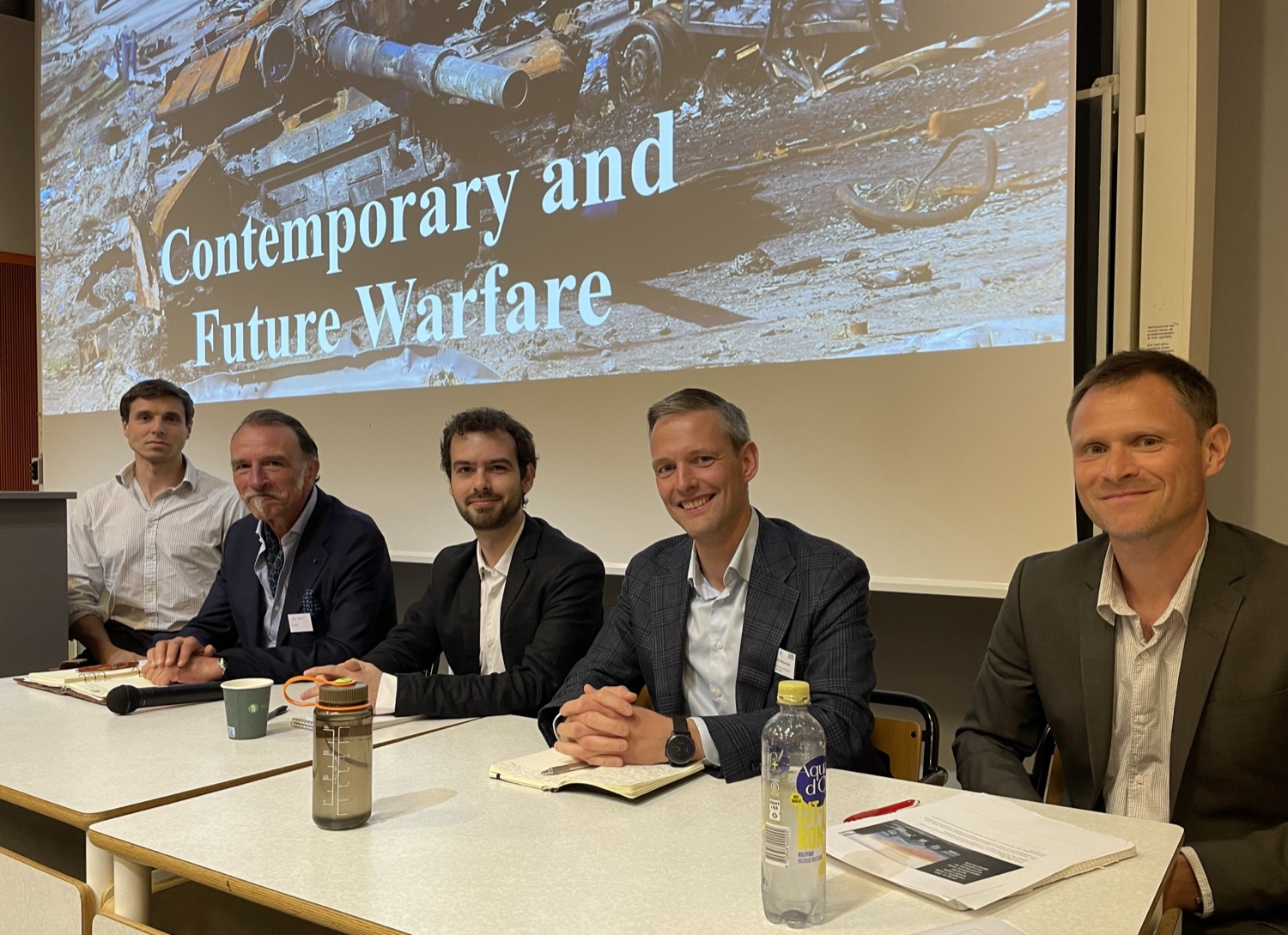
Eine 45-sekündige stumme Montage von der Konferenz 2026 an der Universität Stockholm: das Konferenzplakat vor Raum 8, ein Panel über gegenwärtige und künftige Kriegführung, Teilnehmende auf der Treppe zwischen zwei Sitzungen, ein Blick über die Stockholmer Altstadt und die Postersession. Am Ende stehen die Logos von NetSec, EISS, der Universität Stockholm und COST mit dem Hinweis „Finanziert von der Europäischen Union“.
Konferenzgalerie

Aus dem Archiv
Konferenzprogramm
Das vollständige Programm aus Panels, Roundtables und Vorträgen, wie es stattfand. Öffnen Sie eine Sitzung, um ihre Beiträge und Vortragenden zu sehen.
Vortragende:r
Day 1 — Thursday 11 June
-
09:00 to 09:30
-
09:35 to 09:45
Introductory Remarks
-
09:45 to 11:00
Taking Stock of European Security in a Rapidly Changing Geopolitical Environment
-
11:00 to 11:15
Break
-
11:15 to 12:30
Virtually Transformed? Digital Infrastructures, Competition, and Governance
Beiträge anzeigen (4)
-
Knowing cybersecurity: The epistemic infrastructural power of big tech
Big tech companies authoritatively produce data, information, and knowledge about cybersecurity threats to individuals, businesses, and states. But how do they render international cybersecurity phenomena knowable? Through which practices, means, and devices is this knowledge generated? This paper argues that examining the epistemic infrastructural power of big tech companies addresses these questions. Drawing on International Relations and Science and Technology Studies scholarship highlighting infrastructure’s role in knowledge production, the paper first conceptualizes epistemic infrastructural power. Second, it integrates this conceptualization with big tech companies’ unique position forming the infrastructural core of digitized societies, economies, and lives, alongside existing analysis of their security governance role. This develops a conceptual lens enabling exploration of diverse empirical manifestations of big tech epistemic infrastructural power, particularly regarding cybersecurity knowledge production and performativity. This matters politically because cybersecurity knowledge production is not a neutral or a-political endeavor, but a type of practice that co-constitutes entities and relations in the world by naming, categorizing, producing, and presenting specific realities or truths, serving as references for governance and policy decisions and practices. Third, the paper demonstrates this analytical framework's value by exploring Microsoft’s cybersecurity knowledge production during the Ukraine war. Extensive use of Microsoft products in Ukrainian public and private digital infrastructure enabled the company to collect, monitor, and analyze data about malicious network activities, positioning Microsoft as a significant gatekeeper and communicator of war-related cybersecurity knowledge. The paper concludes by reflecting on what governance object cybersecurity becomes through these dynamics and discussing wider implications for global security governance. The analysis reveals how big tech companies’ infrastructural position grants them distinctive epistemic authority in defining cybersecurity threats and shaping corresponding governance responses, raising critical questions about knowledge power in contemporary international security.
-
Governing cybersecurity and the politics of state control in the digital age
·
Digital technologies have become deeply entangled with the fabric of contemporary societies. Data infrastructures and cybersecurity practices underpin not only economic activity but also state authority and national security. This growing entanglement gives rise to a central question: how are states reorganizing their authority structures and cybersecurity policies, when digital infrastructures are simultaneously strategic assets and commercial commodities? To address this question, we develop a comparative framework investigating how states design cybersecurity policies across institutional and technological contexts. We distinguish between centralized or fragmented authority, on the one hand, and capacities-based or rules-based cybersecurity policies, on the other. These distinctions serve us as a typology of state control over cybersecurity. First, ‘controllers’ possess the ultimate authority and capacity to command and control. Second, ‘custodians’ set agendas and align a variety of government actors without delegation. Third, ‘incentivizers’ influence third-party behavior indirectly through mostly material and legal incentives. Fourth, ‘managers’ exercise delegated authority over day-to-day implementation. We argue that the evolution of these models is shaped by the interaction of two factors: the demand for securing cyberspace and technological complexity. Empirically, we take a longue durée and focus on a single rising power, India. We analyze the temporal evolution of cybersecurity governance within India from 1950 to 2025, with a focus on information and communication technologies (ICT) – the backbone of all digital infrastructures. We identify four phases, each corresponding to one of our four types of state control. Our case study illustrates the politics of digital infrastructures. While less state control redistributes power to firms embedded in critical infrastructures, but also creates incentives for regulatory capture, states simultaneously seek to retain control through coercive backstops and “
kill switches
”. The paper thus speaks to broader debates on the hybrid ordering of security in the information age. -
Cyber risk logics and their implications for cybersecurity
·
Cybersecurity in national and international security is frequently discussed in an existential register. However, most cybersecurity activities are normal and routine, including diverse practices of cyber risk management. The intricacies of cyber risk and its connection to security and threat politics have received surprisingly little attention in the cyber politics literature. This article addresses this gap through a twofold theoretical proposition. The first argues that cyber risk in policy and practice inhabits a continuum between ‘classical’ risk and security postures. The second proposes the existence of multiple risk logics, located at different points along this continuum. To illustrate this, we outline two distinct cyber risk logics: ‘risk as potential threats’ and ‘risk as uncertainty’. Through an exploratory case-study of cyber risk policy and guidance in the United Kingdom, we find indications of the simultaneous existence of these risk logics, including in specific organizational contexts. We propose that the ‘risk as potential threats’ logic, in particular, acts as a ‘bridge’ between conventional risk and security. We conclude by discussing how differentiating cyber risk logics facilitates a more finely grained appreciation of cybersecurity policy and practice and provides opportunities for disciplinary engagement with the organizational and institutional politics of cybersecurity and ‘the international’.
-
Do Parliaments Dream of Cyber Power? Parliamentary Scrutiny in the Strategic Domain of Cyberspace European Security Studies Prize
Cybersecurity has become central to strategic competition and foreign policy, yet research has focused primarily on executive decision-making, military doctrines, and national cyber strategies, marginalising parliamentary roles in this securitised and technically complex domain. This paper examines how legislatures scrutinise cyber policy in democratic systems. Using the framework of authority, ability, and attitude, the paper conceptualises parliamentary scrutiny as a form of strategic oversight shaped by legal prerogatives, institutional capacities, and political incentives. Building on the literature on parliamentary war powers and intelligence oversight, it shows how cyber policy blurs boundaries between defence, intelligence, law enforcement, and critical infrastructure governance, thereby challenging established mechanisms of democratic accountability. The study relies on an original dataset of EU cybersecurity policies and a comparative analysis of five cases: the United Kingdom, Italy, France, Germany, and Spain. Combining text-as-data techniques, parliamentary metadata, and Institutional Grammar 2.0, it examines who speaks about cyber policy, how extensively, and with which institutional powers. The findings reveal substantial variation in parliamentary scrutiny, shaped by institutional arrangements, strategic ambiguity, and executive dominance. By situating cyber policy within debates on civil–military relations and foreign policy decision-making, the paper advances understanding of democratic oversight in emerging strategic domains.
War and Peace Abroad: Security Assistance, Multilateral Operations, and Peace‑Building
Beiträge anzeigen (4)
-
Mapping Plural Visions of Peace: The Peace Cube as an Analytical Framework
·
Recent debates in peacebuilding have moved beyond the liberal peace paradigm to emphasize plural, locally grounded understandings of peace. However, despite this “
local turn,
” the field still lacks systematic tools for conceptualizing and comparing diverse visions of peace across actors and contexts. This article addresses this gap by proposing a new conceptual framework - the peace cube - as an analytical tool to visualize and compare different visions of peace across actors and contexts. Integrating insights from existing typologies that distinguish between levels, domains, and values of peace, the peace cube offers a multidimensional structure that captures the complexity and relational nature of peace visions. The article demonstrates the utility of this model through the case of Colombia, where the Duque government, civil society groups, and feminist actors articulate distinct yet interrelated understandings of peace. By mapping these visions within a shared conceptual space, the peace cube highlights tensions, overlaps, and potential areas of dialogue between competing perspectives. Ultimately, this approach contributes to a more systematic and plural understanding of peace, offering a practical tool for bridging conceptual divides in peacebuilding theory and practice. -
Interpreting Counterterrorism in African Conflict Management
·
Scholarly attention to the convergence between international conflict management and counterterrorism has expanded significantly, though with an implicit interpretation of the ‘use of force’ logic, and an emphasis on UN peacekeeping’s downsizing of protection and human rights norms in engagement with the concept (Moe, 2021; Geis and Moe, 2023). Furthermore, terrorism-related violence is on an unprecedented rise in Africa, with several armed conflicts being embroiled with jihadist actors. African states over the last decade have increasingly pursued counterterrorism through informal coalitional arrangements and bilateral interventions, characterised by expansive force mandates and minimal accountability mechanisms. This paper advances a structured conceptual framework for understanding counterterrorism in international conflict management by identifying four analytical tensions: (1) militarisation and ‘use of force’; (2) organisational density and overlap in coalitions; (3) organisational capacity for prevention-focused mandates; (4) localised meaning-making and contested legitimacy. Building on the ADHOCISM dataset (Maglia, Karlsrud & Reykers 2025), we specifically analyse how these tensions manifest across UN-mandated integrated operations, UN-authorised autonomous interventions, and non-UN operations. The goal is to show and explain the critical shift in African conflict governance, characterised by the declining relevance of UN-centric peacekeeping frameworks and a parallel emergence of militarised ad hoc coalitions with differing levels of protection standards.
-
Socialized to Cooperate? Foreign Military Training and Coordination in UN Peacekeeping Operations
·
United Nations peacekeeping operations (PKOs) are inherently multinational and rely on coordination among national contingents with diverse military cultures, doctrines, and rules of engagement. While existing research shows that mission composition and prior in-mission experience shape peacekeeping effectiveness, we know far less about whether coordination begins before deployment. This paper argues that foreign military training functions as a pre-deployment socialization mechanism that fosters cooperation in multinational peacekeeping settings. Drawing on literature on military socialization and coalition learning, we hypothesize that officers who receive foreign military training—particularly in the United States—develop greater trust in multinational command structures and increased willingness to cooperate with foreign counterparts. We test this argument using a mixed-methods design. First, we field an original vignette experiment with 196 Turkish military officers to examine whether U.S.-trained officers are more willing to comply with operational requests from foreign commanders. Second, we complement the experimental evidence with an observational analysis of UN peacekeeping missions from 1990 to 2016, assessing whether missions with higher proportions of U.S.-trained personnel are more effective in reducing battle-related violence. Our findings suggest that foreign military training is associated with greater openness to international cooperation at the individual level and improved coordination at the mission level. These results contribute to debates on peacekeeping effectiveness by highlighting the micro-level social foundations of coalition cohesion and have policy implications for the design of training and exchange programs.
-
From rebels’ to State’s justice: post-conflict justice choices in 2026 Syria
How do rebels deliver justice when they reach power? This contribution examines post-conflict justice choices in Syria following the political transition of December 2024, focusing on how the new leadership under Ahmad al-Sharaa needs to address widespread human rights violations committed during the al-Assad era. These violations include crimes perpetrated both by the former regime (chemical weapons use, torture in detention centers, disappearances) and by non-state armed actors, notably the Islamic State (genocide of Yazidi community, terrorist violence) as well as other militias like Hayat Tahrir al-Sham (Ahmad al-Sharaa’s group). Drawing on security studies and transitional justice literature, the paper analyzes the emerging Syrian justice architecture and explores how choices of retributive or restorative justice affect stabilization and violence prevention in post-conflict Syria, i.e., how justice choices impact “
security.
” The analysis examines retributive justice initiatives, including the use of universal jurisdiction by courts in Germany and the United States, alongside the reactivation of Syrian national courts to prosecute serious crimes committed by the former regime and the Islamic State. It assesses how the al-Sharaa’s regime frames these retributive choices within a rather standard conception of security governance, focused on two ends: bringing stabilization (by preventing further violence), and consolidating institutions (to deter further violence). The paper contrasts these choices with restorative justice mechanisms also largely introduced by the new authorities, such as the National Commission for Missing Persons and the National Commission for Transitional Justice. These restorative approaches focus on reconciliation; According to the al-Sharaa’s government, they aim to rebuild trust between civilians and institutions, rather advancing a “human
” understanding of security. Will al-Sharaa prosecute crimes by militias (including those of HTS)? Which and whose crimes will be prosecuted?
-
-
12:30 to 13:25
Lunch
-
13:30 to 14:30
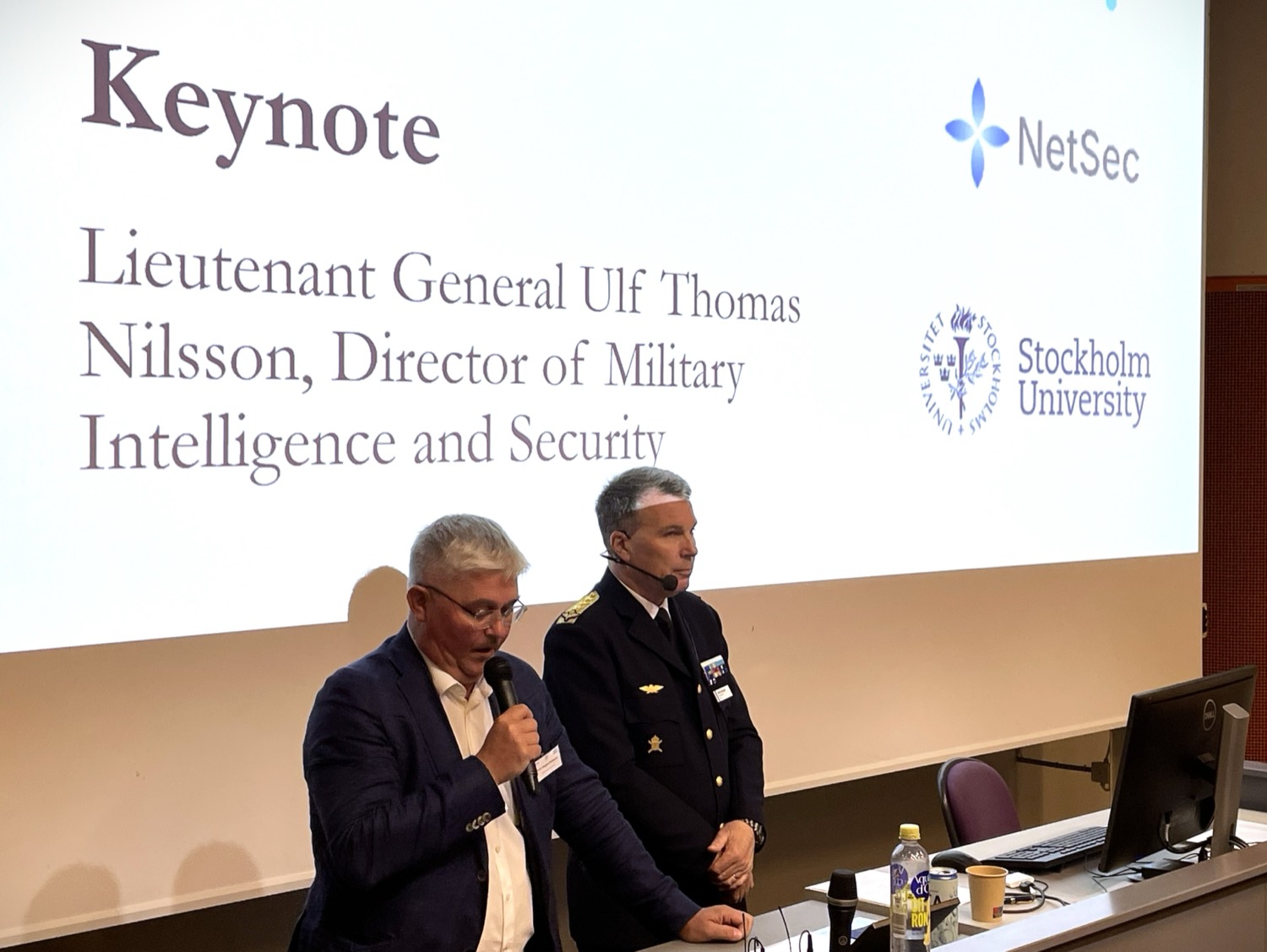
Keynote by the Director of Military Intelligence and Security, Swedish Armed Forces
-
14:35 to 15:50
Nuclear Weapons in a Changing World: From Deterrence to Arms Control
Beiträge anzeigen (3)
-
Upload Pending? Tradeoffs, Uncertainty, and Damage-Limitation in a Multipolar Age
How does China’s nuclear modernization affect U.S. nuclear strategy? What are the crisis bargaining and crisis stability implications of the emerging nuclear balance between the United States and China? How might the nuclear balance evolve over time? This paper addresses these questions. I argue that by building more hardened targets, China is imposing a damage-limitation tradeoff on the United States. In addition, the deployment pattern of China’s intercontinental ballistic missile (ICBM) silos, the growth of its air defense and counterspace capabilities, the adaptations of its mobile ICBM force, and the development of countermeasures against U.S. ballistic missile defenses are imposing damage-limitation uncertainty. Achieving meaningful damage-limitation is possible, but it depends on making optimistic assumptions about variables whose value will be difficult to know prior to a counterforce operation and that are likely to grow worse over the course of a conventional war. Plus, even if the United States achieves meaningful damage-limitation, it would leave itself vulnerable to Russia’s nuclear forces. This state of the strategic nuclear balance between the United States and China should reduce the crisis bargaining benefits of pursuing a meaningful damage-limitation capability while preserving the potentially escalatory dynamics of such a pursuit. It will also generate an intense cross-domain nuclear arms race in which it will be difficult for the United States to escape a condition of damage-limitation uncertainty despite technological advancements in weapons accuracy and remote sensing of mobile nuclear platforms. More broadly, this research indicates that a state of mutually assured destruction (MAD) will be difficult to sustain, but a condition of damage-limitation uncertainty is potentially durable.
-
From Precision to Existential Risk: Hypersonic Weapons and the Erosion of the Conventional–Nuclear Divide
Recent hypersonic weapon technology advances have changed military power, challenging conventional and nuclear warfare distinctions. Hypersonic glide vehicles and cruise missiles, promoted as precision, speed, and deterrence, are compressing decision-making timelines, circumventing missile-defence architectures, and blurring strategic stability-underpinning escalation thresholds. This paper examines how hypersonic weapons break the conventional–nuclear divide and introduce existential risk even without nuclear payloads. The paper has three main points. First, hypersonic weapons undermine warning and response systems, increasing pre-emptive action and launch-on-warning incentives. Second, their integration with advanced intelligence, surveillance, reconnaissance, and emerging AI-enabled command-and-control systems increases misperception, automation bias, and accidental escalation, especially in fragile deterrence regions. Third, prestige politics, defense-industrial competition, and perceived vulnerability drive hypersonic development, similar to nuclear arms racing. The paper uses the Ukraine war, the May 2025 India–Pakistan confrontation, and the Iran–Israel escalation to demonstrate how missile defence saturation, drone integration, and precision-strike doctrines are accelerating offensive dominance. Hypothesising hypersonic weapons as a “
conventionally armed strategic force
” with WMD-like effects contributes to military innovation and strategic studies. The paper sheds light on how emerging technologies are changing global security environments and complicating arms-control and risk-reduction efforts by placing hypersonic weapons at the intersection of conventional military innovation and existential security risk. -
Legitimating the Bomb: US Efforts to Manage Public Information about Nuclear Weapons after World War II
The horrific physical, medical, and environmental effects of nuclear weapons underpin long-standing ideas about nuclear deterrence, as well as challenges to their legitimacy and legality. Yet while US planners anticipated the bomb’s immense physical destruction in Japan 1945, they paid little attention to its probable medical and environmental effects. Instead, it was news reports about radiation in the aftermath of the bombings that first raised public concerns and criticisms about the bomb’s health effects. I show that this criticism prompted US officials to manage publicly-available information about the bomb in order to shape its early reception as a powerful – yet still acceptable – weapon. US efforts took advantage of the unique circumstances around Hiroshima and Nagasaki to emphasize the bomb’s physical destruction but downplay radiation effects to domestic and international audiences. In doing so, they also sought to avoid association with chemical weapons, which had been banned in response to public pressure after World War I. I argue that this information management was central to US efforts to build early public acceptance of nuclear weapons. The findings provide insight into contemporary political debates around nuclear weapons, as well as broader questions about the legitimization of new weapons in international politics.
Gender, Politics, and Security
Beiträge anzeigen (4)
-
The Gender politics of LIO contestation: A research Agenda
Since the end of the Cold War, international security has been guaranteed by the so-called Liberal International Order(Ikenberry 2011; Mearsheimer 2019). But its implementation has never been peaceful (Ikenberry 2010) and has always been subject to important contestations (Alcaro 2018). Adopting a constructivist framework (Wendt 1999), we consider the Liberal Order as a system made also by precise values, norms, and ideas (Kundnani 2017). Among them, there is without doubt a precise dimension of values related to gender (Hafner-Burton and Pollack 2002), expressed in key elements as “
Women, Peace and Security
” resolutions or the Fourth World Women's Conference in Beijing (1995). While politics related to gender has not traditionally been a core field of IR, the role that it assumed in the Liberal International Order has made it a key element of contestation of the Order itself. This research aims to show the role of the gender dimension in the contestation (Orchard and Wiener 2022) of the Order. It aims to provide a conceptual framework to consider how gender has been used in different ways and with different aims to contest the international order by various actors. This research develops a typology based on three axes: while having in common the use of the gender dimension, the actors differ in the impact aimed at International Order -either revisionist or reformist-, in the way of contesting the gender dimension - either progressive or conservative- and in the driver to do so - either ideological or strategic. Analyzing three key dimensions of the social construction and contestation, both institutional and societal, of the international order - Foreign Policy, Ideological production, and social movements- this research aims to provide a comprehensive framework of analysis to understand in what ways gender has become a key terrain of normative contestation of the Liberal International Order. -
No Woman's Land: Securitisation of Female Forced Migration in Afghanistan
Forced migration is a phenomenon present in globalisation’s dynamics, as is the absence of women in the conceptualisation of the processes that shape the lives of citizens. At the intersection of these two realities, we aim to analyse female forced migration as a security issue, analysing the absence of gender in the definition of forced migrant by the United Nations. From a methodological standpoint, this research draws upon Feminist Security Studies, as it conceptualises the intrinsic relationship between gender and security. These key terms guide the semi-structured interviews with thirty Afghan forced migrant women, methodological instrument used to include the realities of women, in their own words. By conceptualising gender as a social and cultural construct, and acknowledging that it shapes the experiences of forced migrant women, we contextualised the background from which they depart: Afghanistan. More than four decades of war, compounded by the Taliban’s second takeover, have profoundly eroded women’s rights, prompting the forced migration of Afghan women. Three conclusions are drawn. Firstly, for the majority of the interviewed women, as forced migrants, security is linked to protection from gender-based violence, freedom from fear and human rights protection, and gender specific barriers remain overlooked in the migration journey. Secondly, the realities of women are not represented in the definition of forced migrant. The absence of gender leads to a gap in gender-disaggregated data on migrants flows and a lack of acknowledgment of the gendered challenges along the migration journey. Furthermore, it leads to the invisibility of policies that materially impact women’s lives and security. Thirdly, we acknowledge that in a spectrum of non-politicised, through politicised, and to securitised - existential threat, justifying emergency measures beyond normal political procedures - female forced migration is a security issue, as it is a matter of a particular saliency and political urgency.
-
Artistic Resilience-Building in Lithuania’s Local Security Policy
**Abstract** Lithuanian orphans sing patriotic songs at Šakiai Diakonija, my diaconal workplace, located just a 20-minute drive from the Russian border—and roughly 2 minutes for the medium-range missiles stationed in Kaliningrad. Recentring human security in the investigation of **children’s lives at EU borders**, this contribution offers valuable insights into **pre-conflict preventive security policy**. These Lithuanian Children exemplify the impact of art and music in building social resilience. Their case study reaches beyond the traditional policy programmes implemented in Lithuania, including rearmament policies, civilian drone operation, and evacuation trainings. **Non-traditional resilience-building** with vulnerable youth at the Russian border emphasises everyday artistic methods, targeting higher **psychological resilience** and thus offering youth the tools to deal with the adverse impact of rising military tensions and potential armed conflict. This approach aims to prevent severe psychological pathologies, with positive outcomes for both **individual lives and national health systems**. Following a localised bottom-up approach to security studies, this qualitative case study touches on novel conflict prevention policies that address children’s lived reality within European security politics. The case study draws on **practical social work with orphans, children with disabilities, and vulnerable youth in Lithuania**. It is inherently **transdisciplinary**, employing theory of traditional international relations as well as artistic studies. Building on the **feminist-constructivist** assumption that the personal and political are two interrelated spheres, it pays attention to the political discourses around Lithuanian state security, and their effect on youth’s personal development. Vice versa, lived realities constitute the starting point in constructing national identities, as evident in children’s selecting patriotic songs for the diaconical Christmas celebration. The transdisciplinary, intersectional feminist perspective thus sheds light on the connections between everyday practices and macro-political security. **All in all, this contribution highlights how a bottom-up, resilience-driven preventive approach to conflict reshapes local security policy.**
-
Gendering Non-Traditional Security: A Comparative Analysis of Sexual Violence, Reconciliation and Post-War Development in Bosnia-Herzegovina and Colombia
This paper will focus on the gender-based violence during armed conflicts as a non-traditional security challenge that is affecting the post-conflict development, stability and any peacebuilding effort. The analysis will be situated within feminist studies and will focus on how post-conflict approaches towards policies, reconciliation and reparations need to address sexual violence and the importance of recognising it as a crime that will deeply impact society. Through a comparative case study of Colombia and Bosnia and Herzegovina, the main focus will be on how the reconciliation frameworks have been implemented and whether the gender layer has also been taken into account while the states have begun their healing process. In the case of Bosnia-Herzegovina, even though the ICTY has been a role model in the international jurisprudence scene and has defined for the first time since the World War 2 trials the term "rape" as a war crime, the post-conflict resolutions and reconciliation were proven to be too inconsistent in the face of the true destruction the Bosnian War has brought, while also having trouble helping with their survivors. In the case of Colombia, the non-traditional approach towards gender-based violence during the war has proven to be right, and the transitional justice was incorporated in the peace-building efforts and, later on, the international jurisprudence. The paper will also focus on the differences between the conflicts. Still, it will highlight the most important factors in which gender-based violence has succeeded: underdevelopment, inequality, patriarchy, but also the issue of land, resources and ethnic conflicts. Moreover, the importance of gender-based frameworks is proven to be a significant non-traditional security challenge, but when addressed and implemented correctly, it can bring a change in the reconciliation process and also build a more stable and durable post-conflict stability, while still caring for its citizens and survivors.
-
-
15:50 to 16:00
Coffee break
-
16:05 to 17:20
The Conduct of Contemporary and Future War
Beiträge anzeigen (4)
-
Learning from Ukraine: The West must be prepared for positional warfare
·
Western land-warfare doctrine remains rooted in a manoeuverist logic, assuming that even against peer opponents NATO forces can bypass strongpoints and win through rapid operational breakthroughs. This paper challenges that assumption, arguing that the positional character of the Russo-Ukrainian war is not an exception but rather the likely outcome of any protracted modern conflict fought under near-parity conditions, and that Western forces are insufficiently prepared for this possibility. We begin by clarifying what makes positional warfare distinct from other forms of warfare: high-tempo combat along largely stable fronts in which belligerents “
lean on
” defended lines through repeated, localised attacks that yield limited territorial change. We then derive a theoretical expectation from widely accepted Clausewitzian logic and test this expectation against the post-1945 record of interstate territorial wars. Using the Correlates of War interstate war dataset (through 2010), we show that every long-durée modern territorial war devolved into positional warfare. Our findings carry both operational and political-strategic implications: operationally, that western doctrine, training, and force design should prepare for positional warfare and that failure to do so poses a serious risk to western militaries’ ability to win against a peer opponent. Politically and strategically, our analysis suggests that over-emphasis on a manoeuvre-centric mindset and expectations of a quick win risks fostering miscalculations before a conflict, as well as aggravating civil-military frictions further once war drags on. -
Conceptual Inquiry into Military Deep Operations: A Framework for Analysis
·
The resurgence of large-scale conventional war in Europe and the frequent use of long-range strike weapons in the Russia-Ukraine conflict have revived European interest in deep-precision-strike (DPS) capabilities. In response, several European nations have expanded budgets and efforts to acquire or develop DPS weapon systems, seeking to enhance or diversify their strike capacity. Prevalent debates tend to centre on the weapons and delivery platforms themselves, whilst neglecting the wider operational context in which they operate. This article proposes an operational framework for deep operations that is independent of any particular DPS system. By inferencing from military doctrine and concepts, it offers a comprehensive conceptual basis for understanding DPS. The framework is intended to aid scholars, policymakers and practitioners in analysing, comparing, and shaping DPS capabilities and tactics beyond the conventional suite of cruise missiles, ballistic missiles, long-range rocket artillery, or hypersonic boost-glide vehicles. It also highlights integration challenges across joint forces.
-
Working in the Margins: Can Small State Special Operations contribute to Deterrence?
Many observers believe that Special Operations Forces (SOF) and special operations have been relegated to the margins by the return of deterrence and defence as the dominant military purpose for the militaries of European small states. SOF may find its niche within counter-hybrid warfare, as a flexible response unit to strategic shocks in the Global South, or provide the joint force with valuable, but not indispensable, intelligence based on special reconnaissance. While accepting that conventional and nuclear forces are the bedrock of deterrence and defence, this paper aims to explore how European small-state SOF units may contribute to deterrence posture and, ultimately, to conventional defence. Recognising that SOF should conduct only operations that create operational or strategic effects, the analysis departs from deterrence theory to develop a method for identifying how SOF may be utilised to create the most outsized deterrence effects. Based on empirical examples from the Russian force posture in the Baltic Sea, the analysis provides concrete examples of how special operations may threaten Russian vulnerabilities and create operational and strategic dilemmas, thereby increasing the cost of aggression and lowering the probability of Russian success. The paper argues that the value of European small state SOF will increase if the US pivot towards the Americas and the Indo-Pacific region results in US airpower, intelligence, and targeting capabilities declining in Europe. To compensate for the lopsided conventional balance, the ability to conduct special operations targeting key nodes in Russian A2/AD bubbles, to reduce the Russian navy's freedom of manoeuvre, and to organise stay-behind networks to target Russian targets in the deep becomes a much more valuable addition to the deterrence effect of the joint forces. Moreover, the paper argues that European SOF should develop its deterrence communication to blend overt and covert activities, creating doubt and imposing dilemmas on Russian decision-makers.
-
Domestic Politics and Military Aid to Ukraine: Explaining Disclosure Policies in France and Germany
·
Why have France and Germany adopted divergent – and shifting – policies on disclosing their military aid to Ukraine? We argue that domestic politics, not international signaling or political culture, best explains this puzzle. We theorize that leaders use transparency as a legitimation tool to manage audience costs when their policy preferences diverge from a hawkish public. Conversely, when leader and public preferences align, policymakers revert to strategic ambiguity. Using a most-similar comparison of France and Germany, employing qualitative Bayesian reasoning, we find strong support for our argument. Germany shifted to transparency under Chancellor Scholz following domestic pressure, a policy reversed by Chancellor Merz once preferences realigned. France maintained secrecy while elite and public opinion converged, only partially disclosing aid after domestic criticism. Our findings highlight domestic legitimation strategies in shaping foreign policy secrecy and contribute to the literature on secrecy in foreign policy and on military assistance to Ukraine.
The Politics of Deterrence in Europe
Beiträge anzeigen (4)
-
Reconceptualizing nuclear deterrence and national identity: the cases of Finland and Sweden
Finland and Sweden's decisions to join NATO after Russia's full-scale invasion of Ukraine brought about fundamental shifts of their historical non-aligned security policy, and their approach to nuclear weapons, disarmament, and nuclear deterrence. Drawing on post-structuralist theory about the co-constitution of identity and security policy, this paper compares debates about nuclear weapons in both countries with the aim to reveal how identity-based argumentation was fundamental for long-term policy shifts. The analysis spans from the end of the Cold War, when both Finland and Sweden signed the Partnership for Peace Agreement with NATO, and joined the European Union, to the present. Comparing domestic debates about nuclear issues in both countries, the paper contributes new insights about how nuclear deterrence has been reconceptualized over time, and the role identity has played in relation to it.
-
Ritual deterrence, magic strategies, and nuclear war in Europe
Ritual deterrence is a compelling concept used to describe NATO's efforts, for example, to reassure its Baltic members and deter Russia through the deployment of troops known as enhanced Forward Presence (Mälksoo). Ultimately the deterrent threat relies on the alliance's willingness to use nuclear weapons in response to a Russian attack if other means fail. Describing how that threat produces restraint on the part of an adversary through arcane strategies of "counterforce" targeting, "graduated escalation," and "escalation dominance" has, since the Cold War, been the province of mainly civilian strategists engaging in what some have characterized as theology and others magic (Fraise). In the wake of Russia's 2022 invasion of Ukraine, think-tank and academic magicians have become more explicit in promoting integration of conventional and nuclear forces in the interest of extended deterrence. Meanwhile plans for deploying new nuclear weapons to support the strategy are underway. This paper analyzes official NATO and US declaratory policy, combined with specialist strategic literature, information about likely weapons deployments, and understandings of the environmental and human consequences of nuclear explosions in Europe to anticipate what the transition from "imaginary" wars (Kaldor) to a real nuclear war could entail. It focuses on the precarious security situation of Estonia and draws on historical analysis of a Cold War precedent in NATO plans to defend West Berlin—with particular attention to the mismatch between the assumptions underlying those plans and the likely response from the USSR (then) and Russia (now).
-
Nuclear Futures, Utopias, and the Case for a Renewed ‘Strict Sufficiency’
The return of war to the European soil, coupled with the Trump administration behavior towards its Allies, has considerably altered the security landscape in Western Europe. Confronted with two superpowers in possession of the world's largest nuclear arsenals, a growing number of observers and political actors believe Europe must substantially reinforce its defence capabilities. In France, nuclear deterrence is regularly advanced to highlight Paris's strategic importance on the global stage and, in a context of heightened aggressiveness from Moscow, in addition to the potential reintroduction of military service announced at the end of November 2025, there has emerged a marked inclination to expand the national nuclear arsenal, so as not to fall behind in the arms race. In this article, I argue that there is nothing automatic or necessary in the need to increase the size of the nuclear arsenal or participate in the arms race. In this article, he identifies and rectifies three false, but commonly accepted notions which make such necessity of rearmament look obvious: (1) that these weapons provide protection, when ballistic missiles have made such protection impossible over six decades ago; (2) that the size of existing nuclear arsenals is necessary for deterrence, which is historically incorrect and ignores the emergent deterrent potential of conventional weaponry; and (3) that the possession of nuclear weapons is beneficial in all possible futures: on the contrary, it is irrelevant in some and harmful in others. Thus, the type and level of nuclear armament that is deemed desirable stems from subjective bets on the future, which need to be made explicit in the strategic debate. After clarifying these three points, Pelopidas invites France and Europe to take the multiple threats they face into account instead of focusing on one only and not to address each in isolation. I argue that this is particularly important given the carbon footprint of the arms race and its effects on the perceived desirability of nuclear weapons, which is largely neglected in existing scholarship. I therefore propose a redefinition of 'strict sufficiency' as a criterion for determining the appropriate dimensions of national defence infrastructures, beyond the singular focus on nuclear forces. This proposal could guide French and European public policy, as well as their diplomatic proposals to other nuclear-armed states, with the support of constituencies concerned about the effects of climate change.
-
Plus ca Change: Continuity in the French Nuclear Approach.
French nuclear thinking reflects the aphorism “
Plus ça change, plus c’est la même chose,
” which translates as “The more things change, the more they stay the same.
” Although France’s nuclear strategy has evolved, the way the French think about nuclear deterrence remains anchored in a certain tradition. This thesis aims to show how this is possible. The research questions are: How has traditional French nuclear thinking been sustained over time in the face of shifting strategic imperatives? What practices within the nuclear ecosystem reinforce this continuity, and how are they exercised? It is well established that the genesis of the French nuclear approach has its roots in the early years of the Cold War. Since then, the French have worked to protect this heritage. Overall, the state’s nuclear policy has remained largely unchanged, having “enjoyed remarkable continuity
” (Jurgensen and Mongin 2018, 24). This does not mean that the French nuclear strategy remains unchanged since its inception. Instead, it suggests that the core of the French approach to nuclear deterrence has remained consistent with the strategic thinking developed during the Cold War. This study examines the continuity of French nuclear strategy, exploring how principles established during the early Cold War have been sustained despite international and domestic pressures. It focuses on three historical periods—1991–1995, 2001–2009, and 2014–2025—and analyzes nuclear practices as socially embedded, capturing how continuity is maintained. Using a history-of-ideas perspective, practice tracing, textual analysis, and interviews with nuclear elites, this research identifies three key mechanisms, policing, symbolic reinforcement, and the echo chamber, through which the French nuclear ecosystem maintains continuity. The French case is no exception: continuity is a choice and, like any strategic decision, involves trade-offs. Sometimes, trade-offs entail significant consequences. Yet continuity must prevail, requiring mechanisms to maintain and protect it even in the face of difficulties.
-
-
17:30 to 18:30
Walking Tour of Stockholm
Day 2 — Friday 12 June
-
08:45 to 09:00
Sign-in for Day 2 & Coffee Break
-
09:00 to 10:15
Navigating the Job Market
Geopolitical Power Europe: A Reality Check in Western Balkans and Eastern Neighbourhood
Beiträge anzeigen (4)
-
EU’s Ontological Security and Geopolitical Enlargement
As Manners illustrated two decades ago, the EU’s identity is constructed around shared norms and principles. These norms and the corresponding self-narratives have provided legitimacy, consistency, and unity of purpose among EU members, and have informed the EU's view of the world. The EU has found meaning in its global role as a norm entrepreneur, promoting, with civilian means, the spread of the liberal international order. However, contemporary global power politics have generated multiple challenges to the EU’s fundamental assumptions and narratives about itself, presenting a major ontological security crisis. The EU’s constitutive ideas and its self-perception as a civilian great power are widely contested not only by non-Western authoritarian powers (e.g., Russia and its military revisionism) but also within the Western normative community, by US President Trump’s policies. The paper will argue that while the EU strives to come to terms with the imperative to adjust its self-image and corresponding role to the new geopolitical realities, its enlargement can play a critical role in alleviating anxiety. It provides a space where the EU can maintain a sense of continuity of purpose as a normative power, and an area where its self-image as an influential geopolitical actor relying exclusively on civilian power can be preserved.
-
Geopoliticisation of EU Enlargement in the Western Balkans and Eastern Partnership: A Role-Theoretical Perspective
· ·
The EU’s recently proclaimed geopolitical turn, that we see as an instance of “
transitional order
” (Beasley, Oppermann, and Kaarbo 2026), has reshaped its enlargement policy, transforming it from a predominantly socialising process into an explicit instrument of geopolitical positioning (cf. Privitera et al. 2024). The rapid upgrading of the Eastern Partnership countries into an “Associated Trio
” following Russia’s invasion of Ukraine formalised the narrative framing the EU as a geopolitical power (Anghel 2025). Whereas classical accession conditionality in Central and Southeast Europe assumed primarily gradual normative socialisation, the revival of enlargement in a geopolitical disguise exhibits a growing element of geopolitical “altercasting
” (Oppermann 2024), characterised by more explicit expectations (and possible status rewards) regarding strategic alignment and positioning. While this turn was expected to produce stronger patterns of (re)alignment among candidate countries, the geopoliticisation of enlargement also appears to generate increasingly transactional (or somewhat ambiguous) modes of engagement. This paper, therefore, examines how EU candidates position themselves at the EU integration stage within the transitional international order. Have they gotten fully on board with the Geopolitical Power EU, or do they consider pursuing hedging due to the uncertainties of the “merit-based approach
”? The study uses the original quantitative and qualitative data from the Geo-Power-EU project, including the country-based Interdependence Database containing the entries on political, security, economic, and social spheres before and during the geopolitical turn. We also leverage the original qualitative data from interviews by local experts, journalists, and politicians from 9 countries to assess their perception of the consequences of the geopolitical turn. By using the concepts from foreign policy role theory, we flesh out the processes related to role adaptation and contestation in the times of international order transition at the global level and its momentous implications for Europe and its states. -
Filling the EU’s Identity Void from Without and Within – Forging a Geopolitics of Values
European Commission President Ursula von der Leyen declared her ambition to lead a “
geopolitical Commission
” upon taking office in 2019, at a time when debate over EU “strategic autonomy
” was intensifying. Promoted most visibly by French President Emmanuel Macron during Donald Trump’s first presidency, marked by open doubts about NATO, this debate was driven by growing concern over Russian and Chinese influence in the EU’s neighbourhood, particularly in the Western Balkans (WB6). These concerns spanned the information space and critical infrastructure, extending even to EU member states participating in China’s Belt and Road Initiative. Yet despite heightened rhetoric, the EU’s geopolitical development lagged behind its ambitions and remained largely reactive. This gap became evident during China’s Covid-19 “mask and vaccine diplomacy
” and, more decisively, following Russia’s full-scale invasion of Ukraine in February 2022. These exogenous shocks prompted renewed EU engagement with enlargement. The accession process in the Western Balkans was revived after being stalled in 2019, and pathways were opened for Eastern Partnership countries, notably Ukraine, Moldova, and Georgia. Nevertheless, despite multiple reforms and initiatives, including the 2024 Growth Plan, the EU’s underlying approach toward long-standing Balkan candidates has remained largely unchanged. The return of Donald Trump to the White House in 2025 has further unsettled the international order. US strategic documents now envision a world structured around competing hegemons, the United States, China, and Russia, with Europe relegated to a subordinate role rather than recognized as an autonomous geopolitical actor. The downgrading of democratic values as a policy objective, alongside actions such as the January 2026 US intervention in Venezuela, illustrates this shift. Europe has yet to articulate a coherent response, although divergent visions emerged in 2026 from leaders in Canada, France, and Ukraine. The proposed paper, drawing on data collected within the Geo-Power-EU project, argues that an EU geopolitics grounded in democratic values has a clear demand base among eastern candidates and potentially the Western Balkans. This normative distinction from hegemonic powers represents a strategic asset that should underpin the EU’s approach to enlargement and collective defence. -
From Normalisation to Strategic Stabilisation: Geopolitisation of the Pristina–Belgrade Dialogue within EU Enlargement
· · ·
This paper applies a geopolitisation lens to the Pristina–Belgrade Dialogue, examining how geopolitics have affected the normalisation of the dialogue and to what extent the deterioration of the geopolitical situation in the world opens the space for an alteration in related measures within the broader transformation of the EU enlargement process. Initially framed as a technocratic and depoliticised process aimed at functional normalisation and rule-based convergence, the dialogue has increasingly been reframed as a strategic instrument in the EU’s response to contemporary security challenges. The paper argues that this transformation is driven by the re-emergence of hard geopolitics in Europe, particularly following the Russian invasion of Ukraine, which has recast the Western Balkans as a zone of strategic vulnerability, as well as the latest shift in US foreign policy and security priorities and its subsequent rift with its traditional allies, including the EU. As a result, EU conditionality in the dialogue has evolved from a primarily normative mechanism into a tool of geopolitical stabilisation, prioritising containment of external influence, regional security, and alignment over legal clarity and democratic consolidation. The paper highlights the importance for the Union to balance between short-term stability and entrenching status ambiguity, undermining the EU’s normative credibility. The paper uses data collected from in-depth interviews from officials in Kosovo, Serbia and EU institutions inside the framework of the GEO-POWER-EU project.
-
-
10:20 to 11:35
Cyber and Digital Sovereignty
Beiträge anzeigen (4)
-
AI-Driven Cloud Monitoring and Cyber Situational Awareness in European Digital Infrastructures
·
Abstract: Artificial intelligence (AI) and cloud computing, combined with IoT systems through digital interconnection, create virtual environments that merge with physical spaces. The new operational capabilities that these transformations bring to European digital ecosystems create security challenges, governance issues and societal concerns. Existing research on AI-based security solutions focuses on their technical performance, but neglects the effects that these systems have on cyber situational awareness and decision-making, as well as regulatory compliance. This paper examines the improvement of cyber situational awareness through AI-powered cloud monitoring systems and visual analytics tools operating in distributed cloud-IoT environments. The study explores human-AI teamwork in automated systems by analyzing data collected from experimental monitoring platforms and intelligent traffic analysis scenarios to show how this collaboration enables early detection of anomalies and helps people understand cyber events, while organizations work together to respond to security incidents across their shared networks. The analysis explores the practical aspects of governance and operational aspects of European digital environments by assessing their technical performance. The assessment assesses data governance, model transparency and privacy protection, system interoperability, and accountability. The paper, through its interdisciplinary approach, which connects cybersecurity engineering with digital governance and security studies, shows that AI monitoring systems function as socio-technical systems that guide the way organizations assess strategic risks and develop their policies. The results show that critical digital ecosystems in Europe require comprehensive frameworks that combine cutting-edge analytics with governance systems designed to maintain transparent operations for trusted and resilient implementation of intelligent surveillance technology. The research work establishes its value to ongoing digital transformation studies through the connection of technological progress to both practical aspects and organizational elements that drive research development.
-
Quantum-Resilient SATIN and European Digital Sovereignty
This contribution presents and discusses quantum-resilient Space–Aerial–Terrestrial Networks (SATIN) as a crucial enabler of European future-proof digital sovereignty, strengthening secure communications, resilient critical infrastructure, and reinforcing Europe’s leadership across satellite, drone, and terrestrial networking domains.
-
Classical geopolitics in cyberspace: Explaining cyber state behaviour with power position
Cyberspace is a new domain of state security competition that differs from the conventional and nuclear realms, most notably because states are constantly engaged in cyberspace operations below the threshold of armed attacks. This inclines many scholars to use new approaches, both theoretically and empirically, to measure and explain cyber state behaviour. This paper argues that classical neorealist literature, which assumes that geographic features and military resources predict state behaviour, is applicable to the new realm. Building on this, it proposes that the power position of a state, co-constituted by its vulnerability and resources, can explain offensive or defensive behaviour in cyberspace. The paper maps 31 states engaged in cyber security competition and overall confirms classical geopolitics expectations, where vulnerable and resourceful states (“
*land powers*
”) behave offensively, while less vulnerable ones (“*sea powers*
”) tend to behave defensively. The paper sets a counterpoint to the prevailing “cyber exceptionalism
” and contributes to ongoing debates about the offense-advantage in cyberspace, as well as the equalizing effect of cyber conflict on power politics in conventional realms. -
From National Incident Response to Zero Trust: Bridging Cyber Defence Policy and Technical Implementation in Wartime Ukraine
·
The ongoing armed conflict in Ukraine has become an unprecedented stress test for national cybersecurity systems, exposing both the capabilities and the limitations of existing cyber-defence architectures under sustained adversary pressure. This paper examines two interrelated dimensions of cybersecurity governance that have acquired acute relevance for European security: national-level prioritization of cyber incidents, and the adoption of zero trust architecture (ZTA) as a paradigm shift in organizational security. First, the paper presents a multi-factor methodology for prioritizing cyber incidents, intended for use by national CERTs such as CERT-UA. The methodology integrates the Common Vulnerability Scoring System (CVSS) with Ukraine's national criticality levels through a hierarchical structure that provides structured tie-breaking via multi-criteria decision analysis (MCDA). The paper proposes a simulation-based evaluation framework for assessing the methodology's effectiveness in handling high-volume incident streams while preserving a decisive and transparent allocation of resources—a critically important capability for states operating under persistent cyber threat. Second, the paper analyses the concept of zero trust as a promising security paradigm for European critical infrastructure. Based on a systematic review of international ZTA models and practical enterprise-deployment experience, it identifies the principal barriers to adoption – in particular awareness gaps, shortages of skilled personnel, and organizational complexity – and proposes practical recommendations for policymakers and security practitioners. By bridging operational-level incident response with strategic architectural transformation, this paper contributes to an interdisciplinary dialogue at the intersection of cybersecurity engineering, security governance, and defence policy. It offers empirically grounded conclusions relevant to European states seeking to strengthen their cyber resilience amid a shifting threat landscape shaped by statesponsored cyber operations, digital-infrastructure dependencies, and the imperative of collective cyber defence within NATO and EU structures.
Stepping into the Future: Military Technology, Innovation Practices, and Contemporary Challenges
Beiträge anzeigen (4)
-
Selling the Future of War: Discursive Power and Military Innovation
How do ideas about military technology become politically influential? This paper sets out to examines how competing visions of military technology emerge, gain dominance, and shape German defence planning. It focuses on public debates surrounding ‘classic’ (armour, artillery, etc.) and innovative military technologies (autonomous weapon systems, AI targeting, UAS/UGV, etc.), and analyses whether shifts in discursive prominence are reflected in formal defence planning and procurement decisions following Russia’s invasion of Ukraine and Germany’s Zeitenwende. The paper advances an ideational political economy account of military innovation. It argues that under crisis and uncertainty, narratives structure how security problems are defined and which technological solutions appear urgent and legitimate. Private actors, like neo-defence start-ups, promote solutionist narratives presenting innovation as strategically necessary and economically efficient. Through discursive coalitions and epistemic authority claims, certain ideas structure agenda-setting and prioritization in defence planning and procurement while others remain marginal. Empirically, the paper combines large-scale text analysis through Discourse Network Analysis, document analysis, and elite interviews. The core dataset includes roughly three million German newspaper articles (2020-present), defence strategy documents, procurement decisions, capability programmes, and defence firm materials. I trace narrative evolution with Discourse Network Analysis, identify coalitions, and measure shifts in idea dominance (classic versus innovative military technologies), linking these temporally to defence decisions, to demonstrate how ideas become politically influential. This paper aims to answer how competing ideas about military technology shape agenda-setting and procurement in German defence policy and makes three contributions. Empirically, it provides the first systematic, longitudinal mapping of military innovation framing and prioritisation in German defence debates since 2020. Theoretically, it demonstrates how ideational power and solutionist narratives shape security sector prioritization. Methodologically, it shows how discourse network analysis can connect large-scale public debate to defence planning, with implications for understanding how commercially driven narratives influence national security policy.
-
Disclosure and Duplicity: How Technology Influences International Competition
·
How do states manage information when building military capabilities? Some weapons are developed openly while others are concealed within secret programs or disguised behind civilian cover. This article introduces arming strategy as a new dependent variable, arguing that two technology attributes shape the disclosure and deception choices critical to information management: fragility (ease of degrading military advantages upon exposure) and distinguishability (difficulty of separating military from civilian applications). Together, these variables generate four optimal strategies that maximize returns on military power while minimizing costs: reveal, conceal, obfuscate, or distort. Large-n qualitative analysis across the complete universe of modern military technologies provides strong support—most cases show states converging on predicted strategies. The results identify generalizable mechanisms linking technological characteristics to predictable information strategies across diverse historical contexts. The framework enables scholars and practitioners to assess how the features of emerging technologies will affect future international competition.
-
The Self-Reliance Dilemma in Conventional Weapons: When does India Innovate Instead of Import?
Most national defense industries face a dilemma between technological self-reliance and (inter)dependence. While indigenously building weapons increases self-reliance, it can come at the cost of economic and technical efficiency. Conversely, interdependence helps a state integrate into global innovation/production networks and potentially access the most advanced weapons, but forsakes self-reliance for short-term efficiency gains. How do states act in such a dilemma, especially when acquiring large, technologically complex platform weapons systems? Despite being a major rising power, India’s defense industry remains surprisingly understudied in this regard. In this paper, I argue that domestic *belief coalitions* comprising political, military, and technocratic actors shape how India navigates its self-reliance dilemma. In a comparative case study of advanced warship and main battle tank procurement in India, I identify and test the causal role of *techno-nationalist, techno-strategic, and techno-epistemic beliefs* in shaping a higher level of technological self-reliance in naval warfare than in land warfare. My analysis draws on expert interviews with high-level Indian military officials and technocrats, as well as political speeches, policy documents, and strategic doctrines. My findings show that the breadth and robustness of coalitions of different technological beliefs can facilitate defense indigenization and self-reliance or, conversely, entrench existing dependencies by shaping what is seen as feasible and desirable. This paper challenges mainstream systemic and structural explanations of defense technological self-reliance, while enriching sociological and ideational political economy approaches to military innovation and defense studies. My focus on domestic beliefs opens the black box of decision-making in the Indian defense industry, offering an actor-centric perspective on the conditions and drivers that have shaped varied outcomes of the self-reliance dilemma in conventional weapons procurement. India’s emerging role as a significant security and defense industrial actor especially raises the empirical relevance of this research.
-
Sending the Wrong Signals: When Armaments Worry Allies
While the role of armaments, and in particular forward-deployed military forces, as signals of reassurance is well-established in the scholarly literature, existing research has not explored when and why armaments may worry allies. In this paper, I consider disagreements between allies about the right armaments by the patron for the defense of a client as symptoms of defense misalignment, reflecting deeper disagreements about the preferred way of warfare among allies. The article proposes a novel theory of armaments as signals of defense misalignment to explain how certain types of armaments can prove contentious between allies. In essence, armaments can trigger conflicts between allies by transforming abstract defense strategies, drafted by political logic, into tangible, material capabilities. As armaments resolve the contradictions and pin down the ambiguities, deliberately included in the strategy for political reasons, they bring the underlying conflicts, stemming from allies’ divergent security interests, back to the fore. I offer a typology of characteristics that render armaments particularly prone to reveal instances of defense misalignment, and I test my theory through case studies on intra-NATO disputes about the role of nuclear forces for the alliance’s defense during the Cold War. My findings are particularly relevant to the context of European defense today. A better understanding of the role of armaments in revealing instances of defense misalignment is essential for safeguarding political cohesion between European NATO allies.
-
-
11:40 to 12:55
Conceptualizing Military Strategy: From Planning to War
Beiträge anzeigen (4)
-
Fortifying the Eastern Flank: Leveraging Historical Lessons to Create Effective Defence Systems
·
In early 2024, Poland and the three Baltic countries of Estonia, Latvia, and Lithuania announced plans to put up fortifications along their eastern frontier. Yet one lesson that analysts might draw from contemporary experience is that defensive systems of the sort planned for parts of NATO’s so-called Eastern Flank have little to no utility except for sapping precious resources that could be spent elsewhere. We argue that this skepticism towards fortifications is misguided even though defence establishments must be attuned to the risk of catastrophic failure. A conventional defensive system must have depth and enable the ability to go about counteroffensives. A major reason for the historical failures associated with fortifications is because defenders either did not match the imagination of their adversaries or neglected the value of depth and counterstrike options. For those considering how to fortify the Eastern Flank, they must pair static defences with operational as well as organizational dynamism. We offer a framework for how to think about effective defence systems and use various case studies, two of which are drawn from the First World War, to substantiate our argument. We conclude by teasing the implications of our analysis for how Poland and the three Baltic countries can create effective defence systems.
-
Anticipated Failure: Why States Go to War Un(der)prepared
Why do states engage in wars for which they are un(der)prepared? Specifically, why do states enter wars when they have good reason to expect that they will not be able to achieve their strategic objectives with their chosen war plans? To understand why states would go to war with flawed plans, we need to know two things: (1) what options to modify the flawed initial war plan were available, and (2) how states pick among their available options. I argue that civilian-military buck-passing restricts the options states have to modify their war plans. Furthermore, the limits on a state’s latent power and the extent of its actualized military power affects how the state selects among their restricted options. These arguments are illustrated through an examination of German war planning in World War II. Germany revised their war plans to fix expected flaws for Fall Gelb, but went to war with a plan known to be flawed in Operation Barbarossa.
-
Revisiting Multi-Domain Operations: A Historical Reflection on the Respective Roles of Combination and Prioritisation in the Conduct of War
·
NATO’s new operational concept Multi-Domain Operations (MDO) assumes combining various military and non-military tools is essential and beneficial for winning future wars. In this article, we offer a historical perspective to enunciate the MDO’s underlying philosophy. Specifically, we argue that combining tools is not inherently necessary nor beneficial, and that prioritisation of one tool can prove contextually meaningful. To substantiate our claim, we describe how prioritisation prevailed over combination in different historical contexts and especially in the Russian-Ukrainian war (2014-2025). Our argument does not imply that prioritization is always preferable, nor that it will prove decisive in future warfare. However, it suggests that NATO should treat prioritisation seriously, and avoid assuming that it will automatically prevail over its adversaries merely by virtue of combining tools. In addition to its practical implications, the argument also improves our theoretical understanding of grand strategy, strategy, and tactics, thus contributing to the current academic debates on these subjects.
-
Influence as Strategic Infrastructure: China, NATO, and Competition Below the Threshold of War
·
Strategic competition is increasingly unfolding below the threshold of armed conflict, where influence over perception, legitimacy, and coordination might determine the outcomes without the use of force. While widely acknowledged, influence is still treated as an auxiliary component of military and political strategy, framed through information operations or psychological warfare. Furthermore, recent debates appear to have been affected by conceptual inflation, whereby the heavy use of ‘war’ terminology has obscured influence as a distinct strategic arena. This paper aims to fill this gap through a case study that analyses how China and NATO conceptualise influence as a strategic practice that affects cognition, understood not as individual psychology but as a collective environment in which decisions are made. China and NATO’s strategies are compared as contrasting approaches to the use of influence to exercise power: China's Three Warfares strategy treats cognition as an object of long-term conditioning to limit adversaries’ coordination and advance China’s objectives without open conflict; conversely, NATO approaches cognitive warfare from a defence perspective, emphasizing counter-parts analysis, resilience and ethical considerations. This comparison reveals that the distinctions between China and NATO are not based on technology or capabilities, but rather on their strategic thinking, which appear to be characterized by a conceptual asymmetry. Because cognition underpins collective sensemaking, interaction between organizations employing different strategic logics may generate misalignment. The latter can result in mismatched comprehension leading to delayed responses, coordination difficulties, and, in situations of persistent competition, an increased risk of escalation. This paper aims to demonstrate that overlooking cognition as a core strategic variable risks missing how advantage is created in alliance-based security systems long before any force is used, which may produce far-reaching consequences for grand strategy, military planning, and international cooperation.
Politics at the Intersection of Climate, Industrialization and Security
Beiträge anzeigen (3)
-
Water In-Security and Climate Migration in Iraq Analyzing Socio-Economic Threats
·
The 2018 UN GEO-6 report classified Iraq 5th most climate vulnerable globally and the UN have further warned that by 2035, Iraq may meet only 15% of its total water demand if current severe water crises trends persist. Equally, as latest as September 2025, IOM recorded that 186.00 Iraqi people are displaced due to water scarcity. In 2025, the Iraqi parliament, admitted that massive rural water shortages drive farmers and villagers to cities, Environmental changes in Iraq trigger socio-economic issues. The study is qualitative and exploiting a socio-legal approach, the primary data is in the form of interviews which were conducted with selected respondents (7) of various backgrounds, and secondary data from journal articles, books, and credible online sources were analyzed thematically. This study aims to scrutinise water insecurity and climate migration in Iraq. Study, revealed that Iraq faces a water crisis from declining Tigris-Euphrates flows (down 30–40% since 1980s per FAO 2023), threatening agriculture, and ecosystems. Similarly, study indicates the Iraqi water in-security and environmental decline has had a direct effect on agriculture with wheat and barley production falling by 30–40% during recent drought years and climate-driven displacement is on the rise. The study recommended that there is a need to strengthen Iraq water security strategies to address such threats, Iraq requires urgent reforms, domestically, must establish a national water diplomacy body, Hence, regionally, should leverage its 2023 accession to the UNECE Water Convention by engaging international mediators (like the UN) to negotiate binding water agreements with Turkey and Iran. This study provides valuable insights for policymakers and academic community, contributing to a better understanding of regional security dynamics and strategies, while identifying areas for future examination in water insecurity and climate migration in broader Middle Eastern. Climate Change, Migration, Water Insecurity, Iraq, Socio-Economic.
-
Living with the nuclear: Spatio-temporal entanglements, nuclear cultures, and the afterlives of uranium mining
This paper examines how uranium mining in East Germany - embedded in the geopolitical dynamics of the Cold War - produced specific nuclear cultures that continue to shape the present. Framing the management of nuclear legacies as a local and global security issue, the paper highlights how uranium extraction and its afterlives intersect with environmental, health, and societal security concerns across generations. Drawing on the spatio-temporal entanglements of extraction and post-extractive remediation, the article demonstrates that the ‘nuclear’ is not solely a technological phenomenon but is deeply rooted in everyday life-worlds, social relations, and cultural practices. Precisely because of this embeddedness in the everyday, nuclear legacies emerge as long-term security challenges in which risks may become normalized, rendered invisible, or politically depoliticized. By analysing ambivalences - between exceptionalism and banalisation, risk and privilege, destruction and infrastructure, secrecy and everyday life, as well as trauma and nostalgia - the paper shows how uranium mining has shaped identity, memory, and regional belonging. Particular attention is paid to the role of knowledge archives, nuclear cultural heritage, and global circulations of expertise, as well as to the challenges posed by long-term radioactive temporalities. In doing so, the paper contributes to a broader understanding of how the nuclear becomes effective in everyday life and how its material and immaterial afterlives can be remembered, communicated, and responsibly shaped across generations. It argues that the governance of nuclear legacies constitutes not only a technical or environmental concern, but a societal and security-relevant task central to safeguarding the well-being of present and future generations.
-
Fragile Control: How De Facto States Degrade Nuclear Security in the Donbas
· ·
Nuclear security research treats states as the primary managers of nuclear and radiological risk, with non-state actors as key challengers. This overlooks de facto states - separatist polities that exercise territorial authority without broad recognition. We argue that de facto states create zones of authority without recognised responsibility, weakening regulatory control while remaining partially excluded from global nuclear-security governance. Consequently, they undermine nuclear security through regulatory rupture, expanded illicit opportunities, coercive threats and use of force, and governance exclusion. We test these claims using cross-national event data and a case study of Russian-backed separatist regions in Ukraine.
-
-
12:55 to 13:45
Lunch
-
13:45 to 15:00
Military Transformation: Military Innovation and Strategic Change in the Transatlantic Context
Beiträge anzeigen (4)
-
From Platforms to Networks: The Political Hurdles of Transitioning to Data-Centric Warfare
Modern military strategy is undergoing a paradigm shift, moving away from a "platform-centric" model defined by the capabilities of individual assets such as tanks, fighter jets, and carriers toward a "network-centric" model prioritizing connectivity, data fusion, and multi-domain integration. While the operational necessity of this transition is widely accepted, this paper argues that the primary obstacles to achieving actual data-centric warfare are not technological, but profoundly political and institutional. This study analyzes the "politics of transformation" by identifying three distinct sources of friction that hinder the shift from hardware to software-defined defense. First, it examines the political economy of defense procurement, arguing that existing industrial bases and legislative funding models are path-dependent, favoring high-visibility legacy platforms over less tangible network architectures. Second, it addresses inter-service bureaucratic politics, highlighting how data-centric warfare requires a level of interoperability that threatens the budget autonomy and cultural identity of individual military branches. Finally, it explores the sovereignty paradox, where the necessity of allied data-sharing conflicts with national political imperatives to maintain strict control over sovereign information infrastructure. By viewing military transformation through the lens of organizational politics and civil-military relations, this paper demonstrates that "networking" a military is a governance challenge as much as a technical one. It concludes that without significant reform in how political actors value, fund, and oversee defense acquisitions, Western militaries risk possessing advanced sensors that cannot communicate with one another, rendering them structurally unprepared for high-intensity, data-driven conflict.
-
NATO as an Innovation Hub? How Emerging and Disruptive Technologies Are Reshaping Allied Innovation
The literature on military diffusion has traditionally treated alliances as transmission paths through which nationally developed military technologies are disseminated among allies. In this view, NATO is exclusively portrayed as a forum for standardization and doctrinal coordination rather than also a site of military innovation. This paper revisits this understanding by examining organizational and governance changes within NATO following the adoption of its post-2021 Emerging and Disruptive Technologies (EDTs) strategy. Drawing on insights from Science and Technology Studies (STS), the paper explores how the technological characteristics of EDTs, namely their dual-use nature and reliance on distributed, largely privatized innovation ecosystems, are reshaping how military innovation is organized and strategically coordinated through NATO. The analysis traces this shift through interpretive qualitative analysis of program architectures and research outputs of NATO’s Innovation Initiatives, including the post-2021 NATO Science and Technology Organization (STO) Collaborative Programme of Work (CPoW) and the launch of the Defence Innovation Accelerator for the North Atlantic (DIANA) Challenge Programmes. The study shows that EDT-driven interdependencies in scientific expertise and innovation ecosystems are altering transatlantic innovation dynamics, encouraging NATO to institutionalize new forms of engagement with civilian scientists and private-sector actors. These changes have also supported the extension of NATO’s innovation initiatives into structured cooperation with the Alliance’s Indo-Pacific Four (IP4) partners. The paper contributes to a better understanding of how the contemporary changes in the character of innovation are driving institutional change within NATO, positioning the Alliance not merely as a diffusion mechanism for national capabilities, but as a hub through which transnational military innovation linkages are shaping patterns of military capability development.
-
From Rogue States to Russia: How Threat Perceptions Drove Congressional Support for Low-Yield Nuclear Weapons, 1993–2020
In 2020, the United States deployed the W76 2 low-yield nuclear warhead on its ballistic missile submarines, marking a pivotal shift in a contentious, three decade Congressional debate over the role of low-yield nuclear weapons in U.S. nuclear policy. Congress first banned research and development on such weapons in 1993, partially repealed that prohibition in 2004, and then authorized an operational capability in 2018. Drawing on the Congressional record, policy documents, and contemporaneous media reporting as samples of elite discourse, this article examines why legislative approval emerged only in 2018, despite sustained interest in low-yield nuclear weapons within the U.S. defense establishment. The analysis shows that changing threat perceptions were decisive: When U.S. national security discourse emphasized rogue states and terrorism, legislators viewed the strategic rationale for low-yield nuclear weapons as unconvincing and their potential employment against non nuclear adversaries as reckless. As great power competition reasserted itself—especially concerns regarding limited Russian nuclear first use—the defense establishment could successfully reframe low-yield capabilities as necessary for credible nuclear deterrence, enabling Congressional authorization. The article concludes that as long as strategic competition with other major nuclear powers structures U.S. nuclear weapons policy, political support for expanding nuclear response options is likely to endure.
-
Vectorial Analysis of Hybrid Warfare: Directionality, Interaction, and Systemic Effects
The concepts of 'hybrid warfare' and 'hybrid threats' have expanded into a wide, heterogeneous set of typologies, primarily centred on instruments and actors. As the range of activities labelled “
hybrid
” continues to grow, existing approaches increasingly struggle to explain how diverse hybrid actions combine, interact, and generate systemic effects below the threshold of direct armed conflict. This article introduces a vectorial analytical framework for the study of hybrid warfare, conceptualising hybrid actions as directed coercive vectors operating across one or multiple domains and targeting specific institutional subsystems. Building on existing hybrid-threat taxonomies, the framework models each activity according to its direction, magnitude, temporal profile, and degree of coordination with other vectors. This vectorial approach enables systematic differentiation between unidirectional, bidirectional, and multidirectional forms of hybrid pressure and provides a structured means of analysing their cumulative and non-linear effects. Rather than proposing a new definition of hybrid warfare, the article advances a meso-level analytical model that bridges descriptive typologies with decision-oriented analysis. The framework is illustrated through empirical vignettes drawn from contemporary and prospective hybrid-threat target arenas, demonstrating its utility for comparative analysis, simulation and scenario development, and the structured assessment of institutional resilience.
War & Strategy: Strategic Deterrence under Duress
Beiträge anzeigen (4)
-
Explaining Heterogeneity in Public Support for Collective Defense in NATO: Evidence from a Cross - National Survey of Allied Countries
· ·
The deteriorating European security environment underscores the continuing relevance of NATO’s collective defence commitments. Since NATO is a military alliance comprising 32 electoral democracies, the commitment to defend any member relies on the domestic politics of its members. For these commitments to be credible, the alliance requires domestic political consensus and public support for defending allies that become targets of external aggression. However, NATO’s annual surveys reveal striking cross-national heterogeneity among allied states in public willingness to honour their collective defence commitments under Article 5. Despite the increased interest in examining the microfoundations of alliance politics, we still lack systematic explanations for why the publics in some member states are more hesitant to defend allies than in others. To address this important gap, we will analyse data from a unique multi-year survey conducted on nationally representative samples across all NATO countries. Using multilevel statistical modelling, our study will provide the first evidence on country- and individual-level factors that explain the large cross-national variation in public views on collective defence. Our findings will contribute to scholarly debates on the role of public opinion in military alliances and the pressing policy discussions about NATO’s cohesion and credibility.
-
The Confidence Trap: Leader-Advisor Deliberations and the Making of (In)Credible Threats
Conventional wisdom holds that states with superior capabilities, clear interests, and strong reputations issue more credible threats, while weaker states struggle to convince. Yet strong states sometimes fail to convince while weaker states occasionally succeed. Why? I argue that credibility is first formed within internal deliberations, shaped by how leaders interact with their advisors before a threat is ever issued. Drawing on findings from the Judge-Advisor System framework of advice utilisation from social psychology, I develop the Confidence Trap Theory to explain how confidence – the extent to which individuals are certain their judgments are correct – shapes the making of (in)credible threats. Leaders assimilate advice selectively: those who are certain dismiss dissent, reinforce preexisting assessments and issue threats that collapse when tested, while those who are uncertain seek multiple perspectives, second-guess their assessments and produce hesitant, ambiguous signals that adversaries ignore. Advisors differ in how forcefully they communicate advice: those who are certain advocate strongly for their position, while those who are uncertain hedge and dilute the clarity of threats. Using case studies of President Truman’s and Chairman Mao’s decision-making at the start of the Korean War, I test CTT against an allies-influence competing explanation, which conceptualises allied consultation as an external advisory input shaping leaders’ threat construction. On the U.S. side, the analysis examines advisory exchanges with the U.K. and India. On the Chinese side, it examines interactions with the Soviet Union and North Korea. Drawing on English- and Mandarin-language primary sources, I find strong support for CTT in the U.S. case and moderate support in the Chinese case. Truman’s overconfidence produced threats that failed to deter, while Mao’s handling of allied inputs enabled more calibrated threat construction that drew Washington into overcommitment. The findings suggest that understanding confidence dynamics can enhance credibility construction across diverse strategic contexts.
-
Cooperation under Stress: Organisational Compatibility and NATO–EU Cooperation in a Fractured Transatlantic Order
· · ·
Recent debates on transatlantic security cooperation widely assume that renewed political tensions -- most notably driven by the Trump II administration -- have undermined cooperation between NATO and the European Union. Such claims typically rest on assessments of strategic alignment at the political level. This paper argues that these assessments risk running ahead of what is currently known about cooperation as it is organised and practiced. Whether NATO–EU cooperation actually deteriorates under geopolitical strain depends not only on shifts in grand strategy, but also on the compatibility of the organisational and cultural interfaces through which cooperation is enacted. Drawing on inter-organisational relations, organisational theory, and international practice theory, the paper develops a framework that distinguishes three analytically separable but empirically interacting dimensions of cooperation: strategic alignment, structural compatibility, and cultural coherence. Rather than presuming either decline or resilience, the framework treats political disruption as a stress test that reshapes relationships among these dimensions. It generates observable expectations about how political contestation, procedural frictions, and breakdowns in trust and shared routines shape cooperation outcomes under geopolitical strain. The paper is primarily conceptual and framework-building. It uses the framework to take stock of NATO–EU cooperation across three areas central to societal security -- critical infrastructure protection, hybrid threats, and emergency preparedness -- laying the conceptual groundwork for a broader empirical research agenda on inter-organisational cooperation under conditions of geopolitical uncertainty.
-
Small states in the current international war agenda: Between shelter seeking and souverenism
Current international relations are facing with the chapter characterized with so-called war public discourses, as well as decision-making processes which are erasing the international infrastructure based on the rule of law. In such context, so-called big powers have adapted to realist thougths about the functioning of the international system, while small, especially weak states are still de facto "shocked", without effective resources and protection in such circumstances. On that basis, the research question of the paper would be: What the small and weak states do have in "their hands" in performing effective foreign policy in current chapter of international relations? The research would be based on to confronation between classical realism and neoclassical realism, thus putting accent on the personal relations dimension between state representatives in the process of perfoming foreign policy versus the possibilities of rational cooperation between "big ones" and "small ones". In practical sense, the paper would serve in understanding the "mounevering space" that small and weak states have in the possibilities for strategic cooperation with big powers, thus securing sustainability on the shelter seeking basis. Western Balkans states will be used as an empirical examples due to different foreign policy approaches of the mentioned group of entities, as well as their characteristics which classifie them to the group of small and weak.
-
-
15:05 to 16:20
Beyond the State: Securitization, Governance, and Private Actors
Beiträge anzeigen (4)
-
Beyond the State: Voluntary Civilian Pro-Defence Organisations and Security Governance in Georgia
This paper explores how the resurgence of interstate war in Europe following Russia’s full-scale invasion of Ukraine has reconfigured relations between defence and society, with particular attention to the role of voluntary pro-defence organisations in security governance. Over the past decade, states historically alert to Russian imperialism have increasingly embraced comprehensive defence frameworks that extend beyond traditional military institutions and emphasise whole-of-society participation. Building on long-standing traditions of civil resistance and national defence, civilian pro-defence organisations have gained renewed prominence across the Baltics, Nordics, and Central and Eastern Europe. Taking Georgia as a case, this paper focuses on the relational dynamics between the state defence institutions and voluntary civilian pro-defence organisations. More specifically, the paper highlights how state actors seek to transform bottom-up societal mobilisation into a more sustained source of societal resilience and national defence capacity, while non-state actors simultaneously negotiate autonomy, legitimacy, and influence within evolving security and political landscape. These dynamics generate both opportunities and tensions. Hence, moving beyond narrated notions of willingness to defend, the paper explores the practices and interactions through which defence roles are negotiated, contested, and/or redefined. Building on civil-military relations theory, the paper posits that voluntary pro-defence organisations both complement and challenge traditional state authority, blurring the boundaries between civilian and military spheres and redefining the limits of state control over security governance. The paper will draw on textual analysis, semi-structured interviews with representatives of the Ministry of Defence, the Georgian Defence Forces, and voluntary civilian pro-defence organisations, as well as participant observations conducted through field ethnography planned in February-March 2026.
-
From Privateers to Private Maritime Security: Irregular Maritime Actors and the Long History of Delegated Security at Sea
This paper examines the re-emergence of private maritime security companies (PMSCs) in the late twentieth and early twenty-first centuries, situating their rise within both recent developments in maritime security and a broader historical context. Since the early 2000s, PMSCs have become a visible feature of global shipping security, particularly in response to piracy and other low-intensity maritime threats. Their growing role as non-state actors operating in the maritime domain raises important questions about the organization of coercive power at sea and the boundaries of state authority. Drawing on my ongoing PhD research, the paper focuses on the structural conditions that enabled the expansion of PMSCs rather than treating their emergence as a purely novel or exceptional phenomenon. It highlights how the globalization of trade, the rapid growth of the merchant fleet, and the post–Cold War contraction and reprioritization of naval forces created persistent capacity gaps in maritime security provision. Within this context, PMSCs emerged as a practical solution to long-standing challenges of securing vast and dispersed sea lines of communication, particularly in regions where states lacked the resources or political willingness to provide continuous protection. The paper then briefly situates contemporary PMSCs within a longer historical trajectory of delegated maritime violence, comparing them to earlier non-state and semi-state actors such as privateers and chartered trading companies. This historical perspective demonstrates that the involvement of non-state actors in maritime security has been a recurrent feature of naval warfare and maritime order rather than an anomaly of the contemporary era. By placing PMSCs within this longer continuum, the paper contributes to discussions on non-state actors and security governance by showing how states have repeatedly adapted the distribution of authority at sea in response to changing economic, strategic, and technological conditions.
-
Criminalising Solidarity: Border Securitisation, Non-State Actors, and Vernacular Humanitarianism in Europe
Border securitisation, externalisation, and the criminalisation of humanitarian assistance in migration contexts have become increasingly prominent features of European migration governance. This paper explores the phenomenon of the criminalisation of solidarity through a comparative overview of these practices in France, Italy, Greece, and Spain, alongside the liminal case of Serbia as a non-EU transit country along the Balkan route. While in EU migration hotspots, the criminalisation of solidarity is predominantly institutionalised through legal and judicial frameworks, the Serbian case demonstrates how humanitarian assistance can be constrained through informal and extralegal governance practices, producing effects comparable to formal criminalisation. By examining the impact of these practices on non-state actors, primarily humanitarian NGOs, the paper highlights how policies of border securitisation and the criminalisation of humanitarian aid not only target irregular migration, but actively restructure the space for humanitarian action. It argues that such policies not only have severe consequences for migrants and humanitarian actors, but also reshape understandings of the rule of law, human rights, and human dignity. Drawing on the concept of *vernacular humanitarianism*, solidarity is conceptualised as an established, non-institutionalised practice that increasingly becomes an object of security governance. This perspective allows for an overview of how everyday practices of care and assistance are transformed into sites of political contestation, where moral obligation collides with legal restriction and security rationalities. Placed in the context of broader political and cultural transformations of migration governance, the paper explores whether these practices undermine solidarity-based forms of action and contribute to shifting collective values in contemporary Europe. Finally, it examines how the suppression of humanitarian work reconfigures cultural narratives of care, responsibility, and ethics within increasingly securitised migration regimes. **Key words:** *securitisation, border policy, migration, criminalisation, solidarity*
-
The Strategic Logic of Violence During Negotiations
· ·
Negotiations are essential to ending armed conflict, yet we know surprisingly little about how violence evolves during the negotiation process itself. While existing research demonstrates that negotiations are essential for ending armed conflicts, most studies treat “
negotiations
” as a single event rather than a dynamic, multi-round process. This paper examines how armed groups behave across successive rounds of negotiations, asking when, why, and by whom violence is used or restrained during these periods. We argue that actors strategically calibrate violence to signal credibility, control, and commitment. Dominant or established groups often exercise restraint to demonstrate command and seriousness, while smaller, excluded, or newer factions use violence—especially against civilians—to assert capability, expand control, or spoil the process. Empirically, we combine new data on daily levels of violence with information on the timing and structure of peace talks across dyads and negotiation rounds. The unit of analysis is the conflict-day, allowing us to trace shifts in violence both within and across rounds of talks. This paper offers a first step toward understanding how violence operates during the negotiation process, setting the stage for broader questions about why some peace efforts collapse early, why others endure through multiple rounds, and how the sequencing and structure of talks influence the trajectory of violence on the ground.
Extended Nuclear Deterrence through European Eyes
Beiträge anzeigen (4)
-
What are tactical nuclear weapons for? The multiple logics of NATO’s theater nuclear posture
How and why has NATO relied on the option of a tactical nuclear strike as a means of achieving security? The debate over U.S. short- and intermediate-range nuclear weapons in Europe has been ongoing since their initial deployment in 1954. It has become more salient in recent years, however, due to Russia’s nuclear saber rattling in the context of the Russo-Ukrainian war, and the deployment of Russian nuclear weapons in Belarus. These developments have sparked increased discussions about whether NATO’s existing tactical nuclear posture remains relevant and effective. Proponents of maintaining and modernizing NATO’s reliance on tactical nuclear weapons argue that they are critical for credible deterrence and defense. In contrast, critics contend that these weapons are increasingly redundant and vulnerable, and have called for their removal. At the heart of these conflicting perspectives lies a fundamental difference in views about the value of maintaining a tactical nuclear strike option today. To explore these different views, this paper first identifies four key functions that NATO has historically assigned to its tactical nuclear weapons: substitution, linkage, conflict termination, and counterproliferation. It then examines how NATO has emphasized each of these functions at different times, with a specific focus on the interplay between political cohesion and military coherence within the alliance. The paper concludes that the variation in contemporary policy prescriptions can, at least to a large degree, be attributed to which of the four functions NATO members prioritize today. This fourfold typology helps explain the ongoing debate about whether these weapons should be modernized, maintained or removed from NATO’s arsenal.
-
'Europe is Not a Country': Nuclear Patronage and Eurodeterrence Concerns in the Frontline States
Worried about the viability of U.S. extended nuclear deterrence (USED), European leaders have begun considering arrangements of their own — most notably the 2025 Franco-British Northwood declaration. This paper assesses the institutional architecture required for a viable Eurodeterrent. It does so by asking: what are the institutional tradeoffs between credible assurance and strategic viability across different Eurodeterrence scenarios? Extended deterrence inherently involves tradeoffs between patron costs (investments in assurance mechanisms) and collaboration risks (coordination and defection problems among allies). My tentative argument is these cost/collaboration tradeoffs are exacerbated by two European realities: France and the UK are weaker potential deterrence patrons than the United States — making assurance costly — and European protégés have divergent strategic interests — complicating collaboration. While tradeoff specifics vary by Eurodeterrence scenario, their net effect may discount the proximity advantages of European nuclear patronage, undermining its viability. I answer my question in two parts. First, I use extended deterrence and organizational theory to conceptually identify potential tradeoffs across three Eurodeterrence scenarios. Given the perceptual nature of assurance, however, the results require empirical investigation. Second, I use the conceptual framework to guide semi-structured interviews with European policymakers in the frontline states — where the demand-side of deterrence is most acute. The interviews will investigate what Eurodeterrence scenarios protégé policymakers think are viable as a USED supplement or even substitution. Under what conditions might (e.g.) Warsaw trust Paris and London — and more than Washington? A second aim is to complement current patron-focused discussions by incorporating viewpoints from potential protégés with high stakes in Eurodeterrence collaboration.
-
Patterns of Foreign Nuclear Deployment: Understanding Host State Refusal in NATO
Why do states refuse offers to host nuclear weapons on their soil? Much of the theoretical and conceptual focus on foreign nuclear deployment has been on the ‘patron’ or deploying state, or on the strategic incentives behind deployment patterns. While these are important explanatory factors, this paper argues that the role of the host state and its domestic politics need to be analyzed in greater depth to fully understand foreign nuclear deployment outcomes in NATO. This paper uses comparative case studies to develop a theory of host state refusal, examining cases of deployment and non-deployment of American nuclear weapons to NATO allies during the late 1950s and early 1960s. I argue that domestic factors within the host state are important for understanding cases of non-deployment. I highlight the role of anti-nuclear and nationalist sentiment as well as the role of elites in managing the domestic politicization of foreign nuclear deployment. First, I categorize NATO allies into cases of deployment and non-deployment. Next, I demonstrate that US interest in deployment is necessary, but not sufficient for determining nuclear deployment outcomes in NATO. Then, through process tracing and consulting available archives, I find that domestic factors contributed to host state refusal or to the prevention of a deployment offer in several cases, focusing on Iceland, Norway, and mainland Denmark. Finally, I consider the role of domestic politics in nuclear acceptance and why anti-nuclear sentiment did not prevent NATO nuclear sharing in Germany in the late 1950s. This paper utilizes archival material from the Norstad Papers, the US State Department Central Files, the Digital National Security Archive, and the Foreign Relations of the United States series.
-
Conceptualizing Nuclear Umbrellas
Nuclear security guarantees are central to the global security order, yet the notion of the “
nuclear umbrella
” remains conceptually underspecified and inconsistently applied, often inferred from outcomes or equated with alliance membership. This paper (1) reviews the existing literature to identify where and how nuclear umbrellas are theorized to affect outcomes such as deterrence, nonproliferation, alliance cohesion, free-riding, and moral hazard; (2) derives a rigorous empirical definition based on three necessary criteria—a declared nuclear capability, an explicit commitment that includes nuclear use, and at least one ex ante costly signal enhancing credibility; (3) applies this framework to construct a global dataset of nuclear umbrella relationships since 1945; and (4) replicates two prominent empirical studies to provide theoretically grounded evidence of the effects of nuclear umbrellas on international security outcomes.
-
-
16:20 to 16:40
Coffee break
-
16:40 to 17:55
Disruptive Machines: AI, Information Operations, and Cyber Security
Beiträge anzeigen (4)
-
Cybercrime & AI: Resilience-by-Design in the Information Age: Tabletop Evidence on AI-Enabled Cybercrime, Coordination, and Public Trust
Digital technologies are entangling cyber risk, digital infrastructure, and governance. This paper argues that AI-enabled cybercrime is best understood as a transformation of the cybercrime ecosystem rather than merely as a set of new technical tactics. It draws on UC Berkeley’s “
AI-Enabled Cybercrime: Exploring Risks, Building Awareness, and Guiding Policy Responses
” initiative, supported by the Center for Long-Term Cybersecurity (CLTC) and the Berkeley Risk and Security Lab (BRSL), which combines foresight-based scenario planning with empirical tabletop exercises (TTXs) and broader expert engagement (workshops, interviews, surveys). Empirically, the paper synthesizes observations from three convenings: the kickoff tabletop exercise at UC Berkeley (December 2024), the Singapore tabletop exercise (October 2025) and the Tel Aviv exercise (December 2025). Participants from government, critical infrastructure, industry, and academia conducted stress tests of AI-generated malware, deepfake-enabled fraud, and accelerated attack chains. The TTXs explored responses ranging from initial breach investigation to disruption scenarios affecting energy, transport, and water systems. Across the exercises, participants described AI as increasing the “speed, scale, and sophistication
” of familiar criminal motives (money, leverage, access) while lowering technical barriers and reinforcing an underground “marketplace
” model in which specialized actors coordinate (e.g., access brokers, ransomware negotiators, deepfake vendors). Yet the decisive constraints were institutional and societal: teams debated roles, decision rights, and reporting lines before technical evidence could be validated; communications strategy had to balance transparency against rumor and escalation risks; leaders also emphasized human accountability even when using AI to triage large data volumes. The paper concludes with a resilience-by-design agenda relevant to European security studies and practice: decision models for action under uncertainty, more straightforward public-private responsibility sharing for critical digital dependencies, and crisis-communication doctrines that protect public trust while preserving rights. -
Financial (In)Security, TikTok, and the Far-Right Pipeline
While the relationship between far-right extremism, libertarianism, and neoliberalism has long been established, algorithmic recommendation as well as the lucrative professionalisation of content creation are leading platforms like TikTok to impact how financial (in)security feeds into the far-right’s proliferation. The rise in influencers promoting an individualistic ‘entrepreneurial mindset’ alongside aspirational lifestyles that are rooted in politicized identities has encouraged the consumption of narratives and routines that promote far-right values. Drawing on ontological security theory and discourse analysis, this paper asks: how do the ontological (in)security narratives of finance-related content relate to far-right ideology? Amongst the 3,246 TikTok posts and 19,805 comments analysed for this paper, three main ontological security narratives relate to far-right extremism. The first, and most dominant, interprets the red-pilled concept of ‘breaking out of the matrix’ as the act of achieving freedom from a perceived oppressive financial system by accumulating wealth and material resources. In addition to promoting a neoliberal individualist imperative that aligns with the far-right, this narrative frequently displayed senses of shame due to financial instability. The second narrative draws on far-right conservativism to blend financial aspiration with gender, framing success and financial security as dependent on traditional gender roles (e.g., tradwives) and on extremist masculinist views about romantic partners (e.g., choosing between supportive wives and ‘gold-diggers’). The final narrative focuses on the ‘influencer saviour’ which points to the connection between finance, religion and the far-right – specifically in how users address their own ontological insecurity by relying on, and idolizing, influencers who appear to have achieved financial stability. At a time of financial insecurity, developing this facet of the online far-right is crucial to not only better understand the radicalization processes threatening democracy but also to identify the topics that policymakers can address to counter the rise of far-right extremism.
-
Telegram in Russia’s Information Strategy: Evidence from Serbia European Security Studies Prize
Digital platforms have become central arenas of contemporary geopolitical competition, blurring the boundaries between the virtual and the physical, the informational and the political. This paper examines Telegram as a key element of Russia's contemporary information warfare and influence operations, focusing on its role in shaping political discourse in Serbia. While Telegram has often been portrayed as a neutral or even emancipatory communication tool due to its encryption and resistance to state censorship, this paper argues that the platform has been effectively integrated into state-aligned information operations, functioning as a semi-informal extension of Russian strategic influence. Drawing on an original dataset of over 140 pro-Russian Telegram channels operating in Serbia, the study combines network analysis, discourse analysis, and agenda-setting theory to map how narratives related to the war in Ukraine and domestic electoral politics are constructed, amplified, and localised. The findings demonstrate that Telegram enables a dense, transnational propaganda ecosystem that operates beyond traditional media regulation, leveraging platform affordances such as anonymity, rapid reposting, and low moderation to shape public agendas and political perceptions. Rather than relying solely on official state media, Russian influence is diffused through a hybrid network of media outlets, individual influencers, and radical political actors, allowing for plausible deniability and narrative flexibility. The paper contributes to debates on digital transformation and power by showing how digital infrastructures function as strategic assets in contemporary international politics. It highlights the political consequences of platform governance gaps and the growing importance of messaging applications in cyber-enabled influence campaigns. By situating Telegram within broader discussions of digital sovereignty, hybrid warfare, and information security, the paper speaks directly to ongoing debates about the global, political, and societal implications of digital technologies in the information age.
-
Narrative Amplification, Plot Structures, and Emotions on VKontakte: Tsargrad’s Popular Geopolitics in the Russo-Ukrainian War
·
This paper explores narrative amplification and plot structures on VKontakte by focusing on Tsargrad Society and Tsargrad TV’s channels. Key narratives and their sub-stories are presented, accounting for platform amplification patterns measured through the number of likes, analysis of posts, and affiliated comments. This study further develops the concepts of amplification and narrative resistance. VK is the largest social media platform in the Russian Federation, and it is being gradually integrated into a government-led multipurpose application, Max (like WeChat in China). Relying on data scraped from two VK channels, Tsargrad Television and Tsargrad Society (June 2021 – June 2023), the study offers a glimpse into the narratives of more extreme nationalist media outlets, their dissemination, and domestic audience engagement (reactions and comments). Theoretically, the paper is anchored in ontological security studies, narratives, and constructivist approaches to international relations (Steele, 2008; Hagström, 2019, 2022; Wendt, 1992). Mixed-methods approach is adopted as user engagement patterns are explored through descriptive statistics identifying most amplified narratives and periods with high activity. Additionally, narrative analysis is applied when analyzing posts with highest number of reactions and their affiliated comments. The findings reveal a substantial and sharp increase in the number of reactions on Tsargrad TV after February 2022. Two key narrative plot structures dominated Tsargrad’s VK communication after the start of the Russian full-scale invasion: hero-versus-villain and internal traitors. The affordances and audio-visual communication of VKontakte enhance the emotional impact of these stories, mediating pride, loss, grief, affect, or contempt. The paper is concerned with the role of digital media and information in non-military warfare and mobilization (Galeotti, 2023; Jonsson & Käihkö, 2025) whilst reflecting on the role of non-human agents in narrative amplification.
Regional Security in the Balkans
Beiträge anzeigen (4)
-
Western Balkan Criminal Groups and the Transformation of Regional Security
Criminal groups in the Western Balkans are influential non-state actors which informally regulate illegal markets, provide protection, and establish strategic partnerships with political and economic elites. They operate outside, alongside, and sometimes within state structures, and often through robust cross-border networks. They are quite flexible and adapt quickly to the evolving practices of law enforcement agencies, border regimes, and changing regional contexts. In this sense, criminal groups contribute to the emergence of a hybrid security environment in which formal and informal actors coexist and interact, and in doing so, they undermine state governance. One of the greatest challenges for such societies is the manifestation of the so-called “
captured state,
” which corrupts the justice system and renders institutions powerless to deal with organised crime. Organised crime is often viewed primarily through the prism of law enforcement and the judiciary. This paper therefore seeks to move beyond this by analysing criminal groups in the Western Balkans from a different perspective – namely, how they function as actors of informal power and their impact on security governance, territorial control and cross-border stability. In this regard, these dynamics are examined in the context of state-oriented approaches to regional security and inter-state trust in fragile and post-transition contexts, such as South-Eastern Europe and, more specifically, the Western Balkans. In particular, the paper explores how weak institutional capacity, corruption and fragmented regional cooperation serve as enablers that these groups exploit to establish robust and flexible transnational networks. The findings of the analysis in this research suggest that the fight against organised crime in the Western Balkans, in addition to stronger law enforcement and the rule of law, requires institutional reforms, governance-oriented approaches and a deeper understanding of the political and governance roles that criminal groups play within regional security. -
Peace as Stalemate: Bosnia and Herzegovina, Forever Missions and the Strategic Logic of Frozen Peace
More than three decades after the Dayton Peace Agreement, Bosnia and Herzegovina remains subject to a continuous international military presence and extensive external governance, yet without achieving political stability or institutional consolidation. This paper examines Bosnia as a paradigmatic case of forever missions and frozen peace: interventions that successfully prevent renewed violence while entrenching political stalemate. Building on theories of prolonged military intervention, conflict management, and institutional lock-in, the paper argues that the Dayton framework transformed peacekeeping from a temporary stabilisation mechanism into a permanent substitute for political settlement. While empirically centred on Bosnia and Herzegovina, the analysis situates the case within a broader universe of long-term interventions – including Kosovo, Cyprus, and Lebanon – where external military presence sustains stability without resolving underlying political conflict. The paper shows how Dayton institutionalised ethnic vetoes, fragmented authority, and international oversight, producing a condition of managed instability in which peace persists but sovereignty and democratic accountability remain suspended. International military presence, while effective in preventing violence, has thus become structurally necessary precisely because political settlement remains incomplete. Addressing a central but underexplored question in the literature – how long-standing interventions might move beyond stalemate without triggering renewed conflict – the paper identifies the strategic trade-offs that transform peacekeeping into conflict management. It concludes by reflecting on what political recalibration would be required to shift from frozen peace toward genuine settlement, and what the Bosnian case reveals about the limits of military intervention as a tool of political transformation.
-
Pitfalls of Transitional Justice and (In)Security in the Western Balkans: Case Study of Serbia
Drawing on the author's previous work, this paper offers insight into the implementation of transitional justice policies in the Western Balkans after the violent wars that accompanied the dissolution of socialist Yugoslavia, with a focus on the former Yugoslav state of Serbia. This qualitative sociological analysis explores the paradoxical effects of the transitional justice process on Serbian populations and governments since 2001. The Serbian transitional justice process has had, and continues to have, a significant impact on the security of the entire Western Balkans region. The insecurity and instability of Serbian regimes are therefore analysed from a critical sociological perspective (Foucauldian discourse analysis) within the transitional justice framework of post-war liberal democratic development. A selection of key scholarly works on transitional justice in the Western Balkans and Serbia, as well as documents produced by international organisations and institutions, is reviewed. The aim of this paper is to demonstrate how liberal notions of human and minority rights, justice, freedom, equality, rule of law, and peace in post-war societal reconstruction through the transitional justice process can have diverse and unintended consequences that contribute to the destabilisation and insecurity of the Western Balkans, which still struggles to maintain a steady course towards EU and NATO membership. Key words: transitional justice process, (in)security of the Western Balkans, Serbia.
-
Bosnia and Herzegovina on the Edge of European Stability
·
Bosnia and Herzegovina occupies a critical position in the security architecture of the Western Balkans, serving as a nexus of domestic vulnerabilities, regional dynamics, and broader European security concerns. This paper employs the multi-level security framework (Buzan, Wæver & de Wilde, 1998) to examine the intersection of internal political fragmentation, institutional capacity, and external influences, including the European Union, NATO, and neighboring states. By integrating traditional state-centric security analysis with transnational and human-security dimensions, the study highlights the ways in which BiH’s structural complexities shape its resilience to both conventional and non-conventional threats. Methodologically, the study is based on qualitative semi-structured interviews with senior management within BiH’s intelligence, security, and military institutions. These interviews provide nuanced insights into threat perception, operational challenges, and the interplay between domestic capabilities and foreign influence. The paper further situates BiH’s security landscape within the wider Western Balkan region, exploring how regional interdependencies, EU policies, and strategic external actors influence national and sub-regional security outcomes. The findings underscore the importance of coordinated security approaches and highlight the potential for EU engagement to foster strategic stability, while preserving national sovereignty. This analysis contributes to the recent discourse by offering a case study of a post-conflict, geopolitically sensitive environment, illustrating the complexities of aligning domestic security policies with regional and European strategic frameworks. Keywords: Bosnia and Herzegovina, Western Balkans, European Security, Multi-Level Security
-
-
18:00 to 18:30
Concluding Remarks & Award of the European Security Studies Best Paper Prize
-
18:30 to 19:30
Cocktail & Poster Session
Beiträge anzeigen (4)
-
A Shadow in the Clouds: Where Is Germany’s Missile Posture Heading?
The emergence of a “
third nuclear age
” has intensified scholarly attention on how non-nuclear strategic weapons affect nuclear postures under conditions of renewed great-power rivalry. As most research focuses on nuclear-armed states, there remains a gap in understanding how regional powers seek to obtain deterrence benefits through their conventional missile postures and how threat perceptions shape posture choices. This research seeks to address this gap in two steps. First, by comparing the missile postures of different regional powers and drawing on scholarship from nuclear posture analysis, the project develops a typology of three ideal-type conventional missile postures – retaliatory, warfighting, and strategic-escalatory. It then introduces an empirical examination of the emerging German posture by combining procurement data, parliamentary records, and official statements with semi-structured interviews with German policymakers and military officials. The interviews clarify how decision-makers think about likely threat scenarios, target categories, views on first use, survivability, the role of parity with Russian capabilities, and assessments of nuclear–conventional entanglement risks. On an academic level, this project contributes to debates on deterrence beyond the binary nuclear/non-nuclear divide. On a policy level, it provides insights into nuclear–conventional entanglement risks in Europe and implications for future arms control and stability efforts. -
“A Nuclear War Cannot be Won and Must Never be Fought”: Analyzing the U.S. Response to Russian Nuclear Threats in Ukraine
From the onset of Russia’s invasion of Ukraine, Russian leaders have repeatedly issued thinly-veiled threats of nuclear weapons use, challenging long-standing international norms against nuclear coercion. This paper examines the evolution of Russian nuclear rhetoric during the war and analyzes the international community’s response to these threats. Drawing on both official and unofficial statements, national strategies, policy documents, and military actions, this paper argues that while pressure from Russian allies and coordinated Western messaging have helped prevent nuclear escalation thus far, current U.S. policy is insufficient to reduce the risk of nuclear miscalculation as the conflict persists. Furthermore, this paper highlights the significant and often underexamined constraining influence exerted by China, India, and the Global South on Russia’s nuclear behavior. Building on this assessment, the paper proposes adjustments to U.S. policy aimed at reinforcing non-threat norms, including deeper engagement with Global South states, steps to reduce the salience of U.S. nuclear weapons in Europe, enhanced conventional deterrence within NATO, and a temporary pause in NATO expansion during active conflict. Together, these measures seek to strengthen international opposition to nuclear threats and reduce the likelihood of miscalculation in Ukraine.
-
State fragility, power sharing institutions and group inequalities
Economic and political inequalities between ethnic groups have been recently shown as important factors that, in many contexts, can contribute to violent conflicts in most parts of the world. While the empirical picture is complex, the existing studies focus narrowly on armed conflict as a main outcome of interest, overlooking broader forms of state fragility that may precede, accompany, or persist beyond violence. This paper shifts the focus from conflict onset to state fragility and examines how different forms of horizontal ethnic inequality shape countries’ transitions into and out of fragile states. First, I estimate transition probabilities across fragility states for more than 170 countries over the period 1995–2024, using the Constellations of State Fragility framework to capture multidimensional and dynamic changes in state capacity, authority, and legitimacy. Second, I examine how ethnic power-sharing institutions, as measured by the IDC dataset, influence these fragility transitions. Theoretically, the study builds on horizontal inequality and power-sharing frameworks, emphasizing fragility as a dynamic process rather than a static condition. Empirically, the analysis combines transition modeling with cross-country panel data methods. By focusing on fragility transitions rather than conflict alone, this research contributes to more precise measurement and offers policy-relevant insights for early prevention and inclusive governance strategies in fragile contexts.
-
Eine druckbare Version des Programms.
Gastgeber & Veranstaltungsort
Universität Stockholm
Jedes Jahr wird die European Security Studies Conference in einem anderen europäischen Land organisiert. Die Konferenz 2026 fand im Rahmen der COST-Aktion NetSec an der Universität Stockholm statt.
Förderung und Partner
Unterstützt durch Horizon Europe
Die COST-Aktion Networking European Security Knowledge (NetSec) (CA24154) wird vom Horizon-Programm der Europäischen Union unterstützt.